How North Carolina's NP practice rules shape who can precept you
North Carolina still ties every nurse practitioner to a physician through a collaborative practice agreement, and two boards regulate NPs together. Those rules decide which NPs can precept a UNCW student, what shapes their clinic days, and how precepting counts toward their own continuing education. Here is the law as of September 2026.
Get your placement plan
Tell us your UNCW program and where you live. A placement advisor replies with the preceptor and site options that fit your UNCW course.
Two boards, one rulebook
Nurse practitioners in North Carolina answer to two regulators at once, the nursing board (NCBON) and the NC Medical Board, which act through an NP Joint Subcommittee. The nursing rules (21 NCAC 36 .0800) and the medical rules (21 NCAC 32M .0100) mirror each other; the NCBON says NP practice requirements and scope are exactly the same in each set.
The central credential is Approval to Practice: the subcommittee's authorization for an NP to practice within their education and certification, with a physician collaborating under a written agreement. An NP may not begin until the Board of Nursing sends notice that both boards approved the application, and approval must be renewed annually, due by the close of the NP's birth month. AANP classes the state as restricted practice.
That is why UNCW asks NP and CNM preceptors for a current Approval to Practice on top of an unrestricted RN license and board certification.
The collaborative practice agreement behind every NP preceptor
Each NP signs a collaborative practice agreement (CPA) with a primary supervising physician. The rules say it must be kept at every practice site, reviewed at least yearly, and must list what the NP may prescribe, order and perform, with an emergency plan. The physician need not be on site, but the two must stay continuously available to each other. No specific format is required, and a CPA is not an employment contract.
Quality improvement meetings run monthly for the first six months of a new agreement, then at least every six months, with records kept five years. A back-up supervising physician is not mandatory, though the Board expects one when the primary is not consistently available.
Controlled substances add a layer. The NP needs DEA registration, the supervising physician's DEA schedules must be equal to or greater than the NP's, enrollment in the state's Controlled Substances Reporting System follows within 30 days, and one CE hour on controlled substances comes before any such prescription.
For you, the agreement frames what clinic days with a given NP can include, since it lists what that NP may perform and prescribe. PMHNP students, whose courses call for medication management, should ask early what a prospective preceptor prescribes.
The precepting CE credit, and a conflict to know about
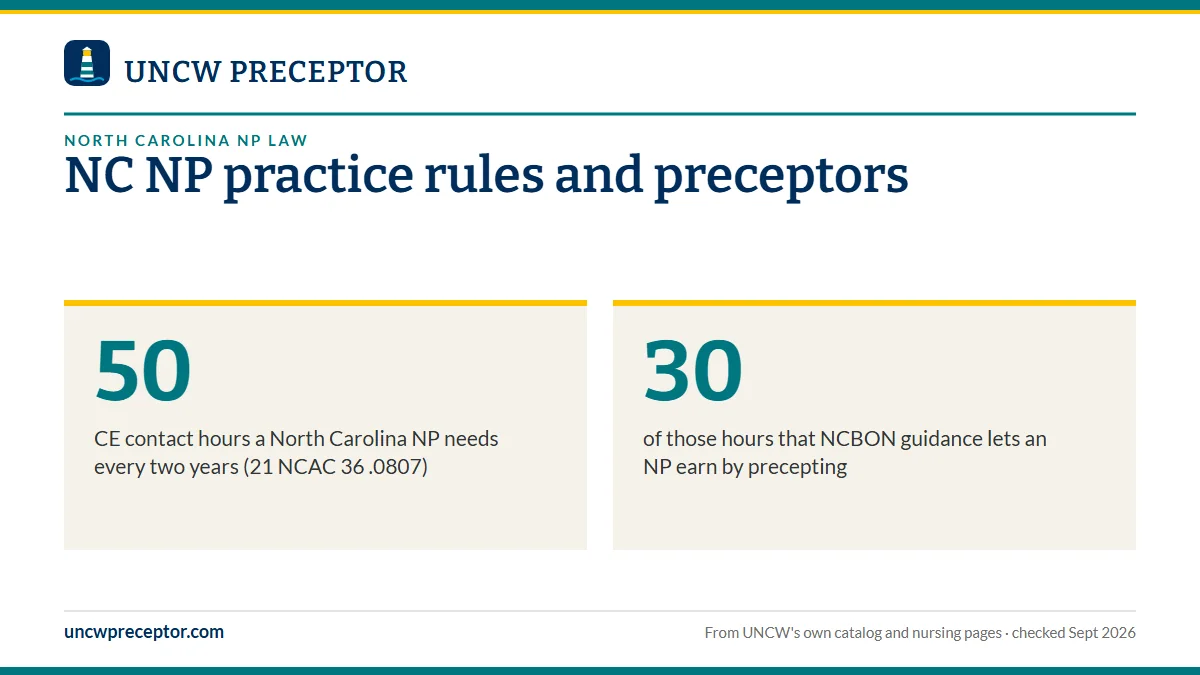
The Board's CE rule, 21 NCAC 36 .0807 as amended July 1, 2024, asks NPs for 50 contact hours of continuing education every two years, at least 20 of them within the NP's national certification, and treats current national certification as compliance. The NCBON's NP CE guidance then allows "Up to 30 Preceptor hours" for precepting any interprofessional healthcare student, backed by an original letter from the program director stating the timeframe and hours.
UNCW's Preceptor's Corner describes the benefit as 30 precepting hours applied to "the annual 50 hours of CE required by the NCBON." The 30-hour figure matches the Board; the cycle does not, because the rule counts 50 hours every two years. Preceptors should plan against the Board's two-year cycle and confirm with the NCBON which documentation satisfies the letter requirement. After each clinical semester, UNCW's Clinical Placement Team sends preceptors a record of the rotation hours they supervised.
UNCW's page says the 50 CE hours are annual; the Board's rule says every two years. When the two differ, the Board's rule governs the NP's license.
What the law says about students and preceptors
G.S. 90-171.43(a)(2) states that the licensing law does not prohibit clinical practice by students enrolled in approved nursing programs under the supervision of qualified faculty. The NCBON's education FAQ calls students unlicensed providers, says the Board takes no approval role over graduate programs that follow licensure, and tells graduate students without an NC or multistate license to contact NCBON Licensure before North Carolina clinicals.
The Board's definitions rule, 21 NCAC 36 .0120(44), describes a preceptor as "a registered nurse at or above the level of licensure that an assigned student is seeking." Research into the rules found no separate license standard for people who precept NP students and no Medical Board position on physicians precepting them. UNCW's own list therefore governs, and UNCW's preceptor requirements sets it out track by track.
No full practice authority yet: the 2025-26 bills
North Carolina has not enacted full practice authority. The APRN Definitions bills, S 537 and H 514, filed in March 2025, stayed in committee. S 966, the SAVE Act filed April 30, 2026, would create an APRN license and remove the physician collaboration requirement; it was referred to Senate Rules on May 4, 2026, with no later action seen as of June. H 696 became S.L. 2026-1 in April 2026 as a Medicaid and health budget law after its 2025 APRN provisions were dropped.
S.L. 2025-37, signed July 1, 2025, created team-based practice for PAs after 4,000 hours plus 1,000 in their specialty and joined the interstate medical and PA compacts. It leaves the NP collaborative requirement in place, and no bill to join the APRN Compact has been filed. Until that changes, every NP preceptor works under a CPA.
How we use these rules in your UNCW search
The law turns into a short check on every NP lead: a current NC Approval to Practice, an unrestricted RN license, board certification, at least a year as a provider and a North Carolina practice. Physician and PA leads need a North Carolina license with no restrictions, plus board certification. We verify those points before a name ever reaches you, and we give preceptors a clear summary of what precepting a UNCW student involves, the CE credit included.
The last word on approval belongs to UNCW's Graduate Clinical Coordinator; our work is making sure the file in front of that office answers every rule on this page. Preceptors can read precepting a UNCW student, students searching statewide can see NP preceptors across North Carolina, and the form below starts your own search.
Questions UNCW students ask
Does an NP preceptor in North Carolina need a supervising physician?
Yes. Every NP with Approval to Practice works under a written collaborative agreement with a primary supervising physician, who must stay continuously available but need not be on site. A back-up physician is expected when the primary is not consistently available, and no bill ending the requirement had passed by September 2026.
How many CE hours can a North Carolina NP earn by precepting?
Up to 30, under the NCBON's NP continuing education guidance, toward the 50 contact hours required every two years. Proof is an original program-director letter giving the dates and hours precepted. UNCW's page calls the 50 hours annual, which conflicts with the rule, so preceptors should follow the Board's two-year cycle.
Can a physician or PA precept a UNCW NP student?
Yes, with conditions. For FNP and AGPCNP, UNCW accepts MDs, DOs and PAs who are board certified and hold unrestricted North Carolina licenses; for PMHNP, psychiatrists and psychiatric PAs. UNCW wants AGPCNP students to train with an NP preceptor at least once across the program, and its clinical handbook asks the same of FNP students.
Do I need my own collaborative practice agreement as an NP student?
No requirement for one appears in the NCBON or Medical Board rules reviewed. You practice under the student provision of G.S. 90-171.43, supervised through your program, and the Board treats students as unlicensed providers. The CPA becomes your task after graduation, with your first Approval to Practice; the NC RN license guide covers that step.
Is North Carolina moving to full practice authority for NPs?
Not yet. AANP rates North Carolina as restricted. The 2026 SAVE Act would create an APRN license and drop physician collaboration, but it went to Senate Rules in May 2026 and saw no later action, and 2025 APRN language was cut from S.L. 2026-1.
Related pages
Last checked 2026-09-24
We check these pages against UNCW's catalog, handbooks and School of Nursing pages. Your course, your cohort's handbook and UNCW's Graduate Clinical Coordinator have the final word.
UNCW asks you to find your own North Carolina preceptor. Let us run that search.
Tell us your UNCW program, your practicum course and where in North Carolina you can travel. We find preceptors who fit the course and prepare the CV, license and agency details UNCW's Graduate Clinical Coordinator reviews, well before the deadline.
- Preceptors matched to the course: primary care, pediatrics and women's health for
NSGL 650toNSGL 653, adult and older-adult care for AGPCNP, psychiatric care for PMHNP - Preceptor CV with dates and site, license number and agency details ready for your submission
- In Wilmington, the Cape Fear region or wherever in North Carolina your clinicals can happen
Start your placement plan
Your program, city and next practicum term is all we need to begin.