UNCW DNP Psychiatric Mental Health NP: two pathways, four practica
UNCW admits psychiatric mental health NP students two ways: a traditional BSN-DNP and an MSN-DNP pathway for nurse practitioners who trained in another specialty. Both lead to the same four practica, NSGL 646 through NSGL 649, each worth 187.5 hours with a North Carolina psychiatric preceptor. The rules around those practica are stricter than in the primary care tracks, so the planning starts early.
Need a psychiatric preceptor in North Carolina?
Tell us which PMHNP practicum is next, and we start the search for a prescriber or therapist who fits.
Two ways into the PMHNP concentration
The credit total depends on which UNCW page you read. The 2026-27 catalog lists 73 credits for the BSN-DNP route, while the PMHNP admissions page still says 70, which was the 2023-24 catalog figure. The dated catalog is the newer source, so plan on 73.
Both routes run online and asynchronously, with a mandatory orientation and designated intensives on campus. Both expect you to hold a North Carolina or multistate compact RN license in good standing, because the clinical work happens in North Carolina, and the BSN-DNP route adds 600 hours of RN work experience before any clinical course. NPs who already hold a DNP have a shorter option, the 31-credit PMHNP Post-Doctoral Certificate.
| Traditional BSN to DNP | MSN to DNP pathway | |
|---|---|---|
| Who it is for | Registered nurses with a BSN | Nurse practitioners in another specialty |
| Credits | 73 in the catalog; the admissions page still says 70 | 64, with NSG 601, NSG 602 and NSG 603 credited from your NP program |
| Plan of study | 8 semesters full time, 14 part time | Not published |
| Practica | NSGL 646 to NSGL 649 | NSGL 646 to NSGL 649 |
| Fall 2027 application | Opened 09/01/2026; deadline 03/01/2027 | Opened 09/01/2026; deadline 03/01/2027 |
The psychiatric courses behind the practica
Six courses carry the specialty: NSG 630 Neuroscience and Psychopharmacology at 4 credits, then NSG 631 on psychiatric assessment and diagnostic reasoning, NSG 632 on disorders, disease management and psychotherapeutic treatment, NSG 633 on group and family therapy, NSG 634 on child and adolescent mental health, and NSG 635 on complex psychiatric problems across the lifespan. Apart from the 4-credit NSG 630, each is a 3-credit course, so the six together account for 19 of your credits.
Five courses must be behind you before NSGL 646: the three advanced practice foundations (NSG 601 to NSG 603) plus NSG 630 and NSG 631. The rest of the degree is the doctoral core and the project sequence, where UNCW's student handbook looks for roughly 120 immersion hours per course.
Four practica at 187.5 hours each
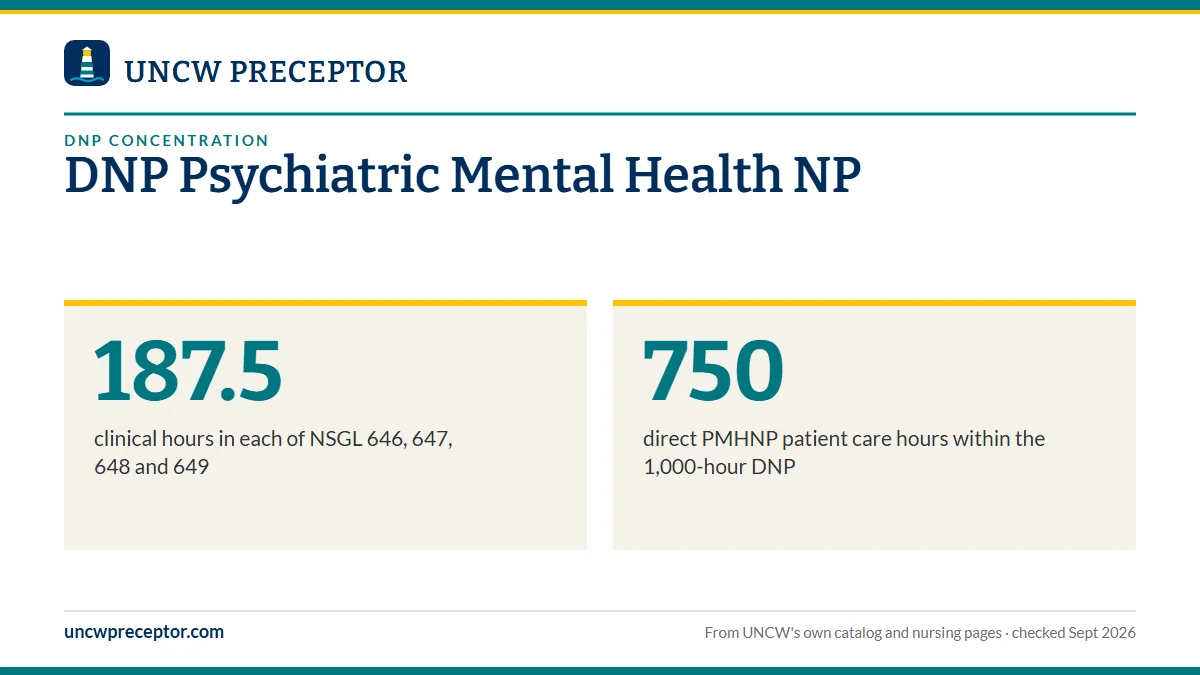
UNCW's plan of study attaches 187.5 clinical hours to each practicum, 750 in all, which lines up with the catalog's 750 direct care hours inside the 1,000-hour DNP. The catalog's own course pages list no hours, so your syllabus is the tiebreaker. Settings cover psychiatric outpatient and inpatient care, and across the four courses UNCW wants a mix that includes both therapy and medication management.
These practica may not be repeated, a stricter rule than the FNP and AGPCNP practica carry. That makes a steady preceptor and a site that truly fits the course more important here than anywhere else in the DNP; the PMHNP practicum course guide sets out what each course expects, and grades and progression covers the wider DNP grade rules.
| Course | Hours | Full-time term | Part-time term |
|---|---|---|---|
NSGL 646 Practicum I | 187.5 | Spring, year 2 (semester 5) | Fall, year 4 (semester 10) |
NSGL 647 Practicum II | 187.5 | Summer, year 2 | Summer, year 4 |
NSGL 648 Practicum III | 187.5 | Fall, year 3 | Fall, year 5 |
NSGL 649 Practicum IV | 187.5 | Spring, year 3 | Spring, year 5 |
PMHNP preceptor rules that differ from the other tracks
- Medication management preceptors are psychiatric mental health NPs, psychiatrists, or physician assistants with a psychiatric focus. The handbook adds that APRN preceptors must work only in psychiatry.
- For therapy hours, an LCSW, LPC, LMFT, LMHC or licensed clinical psychologist can supervise you, provided they hold a full North Carolina license.
- No preceptor may host a second student on a day you are there.
- One site cannot carry you through the whole program, and your own work unit is off limits for clinical hours.
- Preceptors need a year or more of practice at the site you are asking about, and the PMHNP concentration leader signs off on the preceptors and sites students propose.
The Fall 2025 clinical handbook, written around the older course numbers, also caps clinical days at 12 hours, allows telehealth from home within HIPAA rules and your agency's guidance, and keeps telehealth to half or less of all encounters across the rotations. Its encounter minimums are 100 with children and adolescents up to age 21, 100 with adults aged 22 to 59 and 20 with patients 60 or older. Confirm the current figures in your course, and see who can precept for every credential.
Location, timing and the older sequence
PMHNP clinical hours are completed in North Carolina with preceptors licensed there; the North Carolina rule explains the license side. UNCW publishes no separate location rule for the MSN-DNP pathway, and its PMHNP preceptor page asks for North Carolina licenses, so plan on North Carolina sites and confirm with the concentration lead.
Full-time BSN-DNP students begin NSGL 646 in the spring of year 2. Part-time students begin in the fall of year 4 and have no practicum the following spring. Placement details are due to UNCW eight weeks or more before the term, or 90 days before the course by the flowchart in the same handbook, and the search itself should open six months to a year ahead.
Students admitted in earlier years may be on NSGL 643, NSGL 644 and NSGL 645, three 180-hour courses plus residency. The 2024-25 catalog had already switched to NSGL 646 to NSGL 649 while keeping the residency and an even 500 and 500 division of hours. The curriculum transition page compares the sequences.
Why PMHNP students choose us
Psychiatric placements take more matching than primary care, and that is where we do our best work. We search North Carolina for the preceptor each course needs, whether that means a psychiatric prescriber, a licensed therapist, or an inpatient or outpatient setting. Because UNCW expects PMHNP students to move between sites, your placement advisor plans the next site while you are still finishing the current one.
Before proposing a match, we confirm the preceptor has no other student on your clinical days. Then we pull together what UNCW's reviewers look for: an up-to-date CV that lists experience dates and names the practice, the license number, a working email for evaluations, and the agency's legal name, address and county. The file lands complete with time to spare, and should a preceptor leave mid-course, a new search begins immediately. UNCW decides every approval; we make sure nothing in the file slows that decision down.
Questions UNCW students ask
Can a nurse practitioner become a PMHNP through UNCW?
Yes, by two routes. An NP with an MSN in another specialty can enter the MSN-DNP pathway, 64 credits, which credits pathophysiology, assessment and pharmacology from the first NP program. An NP who already holds a DNP can take the 31-credit PMHNP Post-Doctoral Certificate instead. Both use the same four practica and the same North Carolina clinical requirement.
Is the UNCW PMHNP DNP online?
Courses are delivered online and asynchronously, with required trips to Wilmington for the DNP orientation and scheduled intensive days. The practica are in person at North Carolina psychiatric sites, apart from telehealth the clinical handbook allows within limits. UNCW has not published the intensive dates, so ask the program before you plan time away from work.
What happens if I fail a PMHNP practicum at UNCW?
The catalog marks NSGL 646 through NSGL 649 as courses that may not be repeated. Elsewhere in the DNP, a C means repeating the course, only one repeat is allowed in the program, and a second C leads to dismissal. If hours, encounters or a preceptor relationship start to slip, raise it with course faculty early rather than at the end of the term.
When is the PMHNP application deadline?
Both PMHNP pathways admit for Fall 2027 through an application that opened 09/01/2026 and closes 03/01/2027, a month later than the FNP and AGPCNP deadline. The PMHNP Post-Doctoral Certificate uses the same 03/01/2027 date. UNCW admits DNP students once a year, in the fall.
Can I do PMHNP clinical hours at the hospital where I work?
The Fall 2025 clinical handbook rules out clinical hours in the same department that employs you. Your hours must be student time with an approved preceptor, separate from your RN shifts. Ask the concentration leader how the rule applies to other departments of your employer before you approach psychiatric providers there.
Related pages
Last checked 2026-09-24
We check these pages against UNCW's catalog, handbooks and School of Nursing pages. Your course, your cohort's handbook and UNCW's Graduate Clinical Coordinator have the final word.
UNCW asks you to find your own North Carolina preceptor. Let us run that search.
Tell us your UNCW program, your practicum course and where in North Carolina you can travel. We find preceptors who fit the course and prepare the CV, license and agency details UNCW's Graduate Clinical Coordinator reviews, well before the deadline.
- Preceptors matched to the course: primary care, pediatrics and women's health for
NSGL 650toNSGL 653, adult and older-adult care for AGPCNP, psychiatric care for PMHNP - Preceptor CV with dates and site, license number and agency details ready for your submission
- In Wilmington, the Cape Fear region or wherever in North Carolina your clinicals can happen
Start your placement plan
Your program, city and next practicum term is all we need to begin.