UNCW DNP Adult-Gerontology Primary Care NP: courses, hours and preceptors
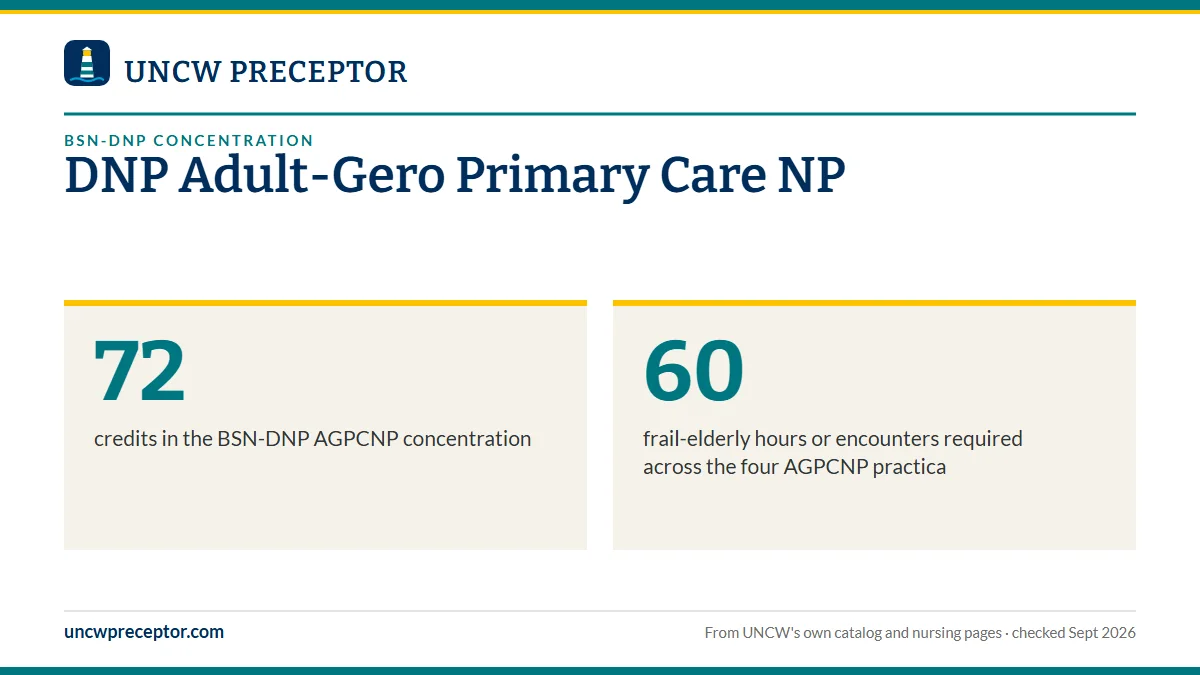
The AGPCNP concentration prepares you to care for patients from age 13 through the end of life, in 72 credits and four practica completed in North Carolina. Two clinical rules set it apart from the family track and shape your search: at least one preceptor has to be a nurse practitioner, and you must document frail-elderly care. Here is how the program is built and how we help you fill each practicum.
Looking for an AGPCNP preceptor?
Share your course number and term, and we start matching you with North Carolina adult-gero sites.
What the AGPCNP concentration includes
Much of the AGPCNP curriculum is shared with the family track: pathophysiology in NSG 601, advanced assessment in NSG 602, pharmacotherapeutics in NSG 603, adult health in NSG 612, and the doctoral core in evidence, statistics, policy and systems. Three courses belong to this concentration alone: NSG 616 covers adolescent, older adult and gender health; NSG 617 teaches prescribing and diagnostic reasoning for older patients; and NSG 618 takes on complex health problems.
| Item | UNCW's published figure |
|---|---|
| Credits | 72 (23 courses) |
| Patient population | Ages 13 through end of life, in primary care settings |
| Delivery | Online, with a mandatory on-campus orientation and designated on-campus intensives |
| Practica | NSGL 660, NSGL 661, NSGL 662 at 180 hours each; NSGL 663 at 240 |
| Specialty courses | NSG 616 (4 credits), NSG 617 (2), NSG 618 (4) |
| DNP project | NSGL 696, NSGL 697, NSGL 698 |
| Plans of study | 8 semesters full time or 14 part time |
| Admission | Fall only; Fall 2027 cycle opened 09/01/2026 with a 02/01/2027 deadline |
| Before clinicals | NC or compact RN license and 600 hours of RN work experience |
Practicum hours: two published totals
UNCW's catalog and its AGPCNP plan of study disagree on the direct care total. The catalog requires 1,000 hours, split into 750 of direct patient care and 250 of non-patient care. The plan page instead shows 780 hours of direct care on top of 250 non-patient hours, a combined 1,030, and 780 is also the sum of the four course pages.
For scheduling preceptors, 780 is the practical target: every practicum carries its own 180 or 240 hours, and each block must be complete before classes end for the term. The syllabus and the Graduate Clinical Coordinator decide the program total, and the 1,000-hour guide explains the wider DNP rule.
| Course | Hours | Full-time term | Part-time term |
|---|---|---|---|
NSGL 660 Practicum I | 180 | Spring, year 2 (semester 5) | Spring, year 4 (semester 11) |
NSGL 661 Practicum II | 180 | Summer, year 2 | Summer, year 4 |
NSGL 662 Practicum III | 180 | Fall, year 3 | Fall, year 5 |
NSGL 663 Practicum IV | 240 | Spring, year 3 | Spring, year 5 |
The catalog lists NSG 612 as the prerequisite for NSGL 660 and includes NSG 616 among the prerequisites for NSGL 662, so the didactic courses and the practica move in step; your advisor can confirm the full prerequisite chain.
Frail-elderly care and the other encounter minimums
Every AGPCNP student has to show 60 units of frail-elderly care spread across NSGL 660 through NSGL 663. The plan of study counts them as hours; the preceptor page and the clinical handbook count 60 encounters. Either reading means at least one placement where frail older adults fill a real share of the schedule, such as a geriatric practice, a long-term care setting or an internal medicine group with a large older panel.
| Encounter area | Minimum | Note |
|---|---|---|
| Adolescent | Two categories of 20 | |
| Adult episodic or wellness | 70 | |
| Adult chronic | 70 | |
| Geriatric | Two categories of 70 | The preceptor page labels these rows under 65; the handbook says over 65 |
| Frail elderly | 60 | Hours on the plan of study, encounters on the preceptor page |
| Gynecologic, excluding maternity | 20 | Including 10 speculum or bimanual exams |
| Mental health | 40 | The preceptor page shows 40 men's health visits in this row |
| Men's health | 10 |
Telehealth is capped at 50 encounters for the whole program and has to be done on site, not from home. Because the two UNCW sources differ on a few rows, check the requirement list inside your course and in Typhon before you plan sites around the table.
Who can precept an AGPCNP student
UNCW accepts nurse practitioners, physicians (MD or DO) and physician assistants working in North Carolina, each with a minimum of one year in a provider role, ideally at the practice you are hoping to join. NP preceptors need an RN license, an active NC Approval to Practice and national certification as advanced practice providers; physicians and PAs need North Carolina licensure and board certification. The preceptor requirements page lists every credential by track.
The clinical handbook describes the ideal AGPCNP setting as primary care for adolescents, adults and older adults, or women's health without maternity, with every patient over 13. Urgent care, family medicine, internal medicine, geriatric practices and long-term care are the settings it singles out, and as on every UNCW NP track, the site has to be in North Carolina under the North Carolina clinical rule.
If every preceptor you line up is a physician or a PA, you miss UNCW's rule that at least one AGPCNP preceptor during the program must be a nurse practitioner.
Timing, the 600-hour rule and the older course numbers
Full-time students start NSGL 660 in their fifth semester, the spring of year 2. The part-time plan holds the first practicum until semester 11, the spring of year 4, which gives more time to build RN experience and to search. Either way, 600 hours of work as a registered nurse must be complete before the first clinical course.
Start looking early. UNCW's process map points to a search that begins six months to a year out; the written deadline for placement details falls 8 weeks before the term starts, while the handbook's chart moves it to 90 days before the course. The submission deadline guide sorts out the two dates.
Cohorts admitted before the 2025-26 catalog took three practica instead, NSGL 636, NSGL 638 and NSGL 639, each set at 180 hours, and UNCW's AGPCNP preceptor page still shows only those numbers. If a preceptor has read that page, tell them which sequence you follow; the AGPCNP practicum courses page compares the two.
How we staff your AGPCNP practica
We plan your placements around this concentration's two hard rules. Your placement advisor looks for a North Carolina nurse practitioner early, so the NP requirement is settled well before the capstone, and pairs that preceptor with settings where frail older adults are part of the everyday caseload: geriatric practices, internal medicine groups and long-term care. We also watch the age floor, steering you toward clinics with adolescent and adult volume rather than schedules dominated by young children, who fall outside the AGPCNP age range.
Each match arrives with the paperwork already assembled for the Graduate Clinical Coordinator: the preceptor's current CV with experience dates and the practice site listed, the RN or medical license number, an email for evaluations, the agency name and location with its county, and the person who handles agreements. It reaches UNCW complete and early, and if a preceptor leaves partway through a term, your advisor moves straight to a replacement. UNCW approves each site; we make sure its reviewers see everything they need on the first pass. See how it works or start with the form below.
Questions UNCW students ask
What ages does UNCW's AGPCNP program cover?
Patients from age 13 through the end of life, seen in primary care settings. Children under 13 and maternity care fall outside the concentration, so a family clinic whose schedule is mostly young children or prenatal visits is a weak fit for these practica. Adolescent, adult, older adult and non-maternity women's health visits are the core of the caseload.
Is the UNCW AGPCNP DNP online?
The coursework is online. UNCW also expects you on its Wilmington campus for the DNP orientation and for intensive days during the program, and the schedule for those has not been posted. The four practica are in person at North Carolina sites. Telehealth visits can count, up to 50 encounters in the program, only when you complete them on site at the clinic.
How is the AGPCNP different from the FNP at UNCW?
Both are 1,000-hour BSN-DNP concentrations with four practica and North Carolina clinicals. The FNP is 74 credits and covers newborns through older adults, prenatal care included. The AGPCNP is 72 credits, starts at age 13, and adds frail-elderly care and a required NP preceptor. Choose by the patients you want to serve after graduation; the FNP guide has the family track's details.
Can I use one clinical site for the whole AGPCNP program?
Yes, if that one site can satisfy the objectives of all four courses; UNCW's clinical handbook permits it for every NP track except PMHNP. The site still has to give you an NP preceptor at some point and enough frail older adults, so one site works only when it covers both. Up to 4 preceptors can share a single course.
When is the application deadline for the UNCW AGPCNP?
For the Fall 2027 cohort, UNCW's graduate application opened on 09/01/2026 and closes on 02/01/2027. The DNP admits once a year, in the fall. Applicants need a BSN and an active, unrestricted RN license from North Carolina or a compact state, and 600 hours of registered nurse work must be done before the first practicum.
Related pages
Last checked 2026-09-24
We check these pages against UNCW's catalog, handbooks and School of Nursing pages. Your course, your cohort's handbook and UNCW's Graduate Clinical Coordinator have the final word.
UNCW asks you to find your own North Carolina preceptor. Let us run that search.
Tell us your UNCW program, your practicum course and where in North Carolina you can travel. We find preceptors who fit the course and prepare the CV, license and agency details UNCW's Graduate Clinical Coordinator reviews, well before the deadline.
- Preceptors matched to the course: primary care, pediatrics and women's health for
NSGL 650toNSGL 653, adult and older-adult care for AGPCNP, psychiatric care for PMHNP - Preceptor CV with dates and site, license number and agency details ready for your submission
- In Wilmington, the Cape Fear region or wherever in North Carolina your clinicals can happen
Start your placement plan
Your program, city and next practicum term is all we need to begin.