UNCW's Fall 2025 curriculum change: which practicum courses are yours
Students admitted under UNCW's 2025-26 graduate catalog or a later one take the new DNP practicum sequences: NSGL 650–NSGL 653 for FNP, NSGL 660–NSGL 663 for AGPCNP and NSGL 646–NSGL 649 for PMHNP, plus three DNP project courses. Earlier cohorts may still be on the previous courses. Both sets are running today, and UNCW has published no date when the older ones close.
Get your placement plan
Tell us your UNCW program and where you live. A placement advisor replies with the preceptor and site options that fit your UNCW course.
What UNCW changed, and for whom
The change came with the 2025-26 graduate catalog and covers students admitted under it or any later catalog. UNCW admits DNP students in the fall only, so the Fall 2025 cohort was the first to start on the new sequences. Students admitted before that may remain on the previous curriculum until they finish.
Three things moved at once. FNP and AGPCNP went from three practicum courses to four, with the last one carrying 4 credits and 240 hours. The residency course (NSGL 681) and the single project course taken twice (NSG 699) gave way to three 3-credit project courses, NSGL 696, NSGL 697 and NSGL 698. And the catalog's split of the 1,000 DNP hours shifted from 500 direct patient care and 500 non-patient hours to 750 and 250.
UNCW's FNP preceptor page frames this as a transition rather than a new program: both FNP sequences share the same core learning objectives and the same patient contact hours per course, and the main differences are the course numbers and how the sequence is structured.
The old and new sequences side by side
Course numbers are the fastest tell. A practicum in the 620, 636 or 643 series puts you on the previous curriculum, and one in the 650, 660 or 646 series puts you on the new one, with one PMHNP wrinkle explained under the table.
| Item | Previous curriculum | New curriculum (2025-26 catalog onward) |
|---|---|---|
| FNP practica | NSGL 620, NSGL 621, NSGL 622 (3 credits each) | NSGL 650, NSGL 651, NSGL 652 (3 credits each) and NSGL 653 (4 credits) |
| FNP practicum hours | 180 per course, 540 in all | 180, 180, 180 and 240, or 780 by the course pages |
| FNP total credits | 70 | 74 |
| AGPCNP practica | NSGL 636, NSGL 638, NSGL 639 (180 hours each) | NSGL 660 to NSGL 663 (180, 180, 180, 240) |
| AGPCNP total credits | 68 (2024-25 catalog) | 72 |
| PMHNP practica | NSGL 643, NSGL 644, NSGL 645 (180 hours each) | NSGL 646 to NSGL 649 (187.5 hours each) |
| Residency | NSGL 681, about 120 immersion hours | None |
| DNP project | NSG 699, taken twice | NSGL 696, NSGL 697, NSGL 698 (3 credits each) |
| Catalog hour split | 500 direct patient care and 500 non-patient | 750 direct patient care and 250 non-patient |
PMHNP changed in two steps. The 2024-25 catalog already listed NSGL 646–NSGL 649 but kept NSGL 681, NSG 699 and the 500/500 split; the three project courses and the 750/250 split arrived a year later. If you are a PMHNP student from that cohort, check the project courses on your plan as well as the practica.
How to tell which curriculum you follow
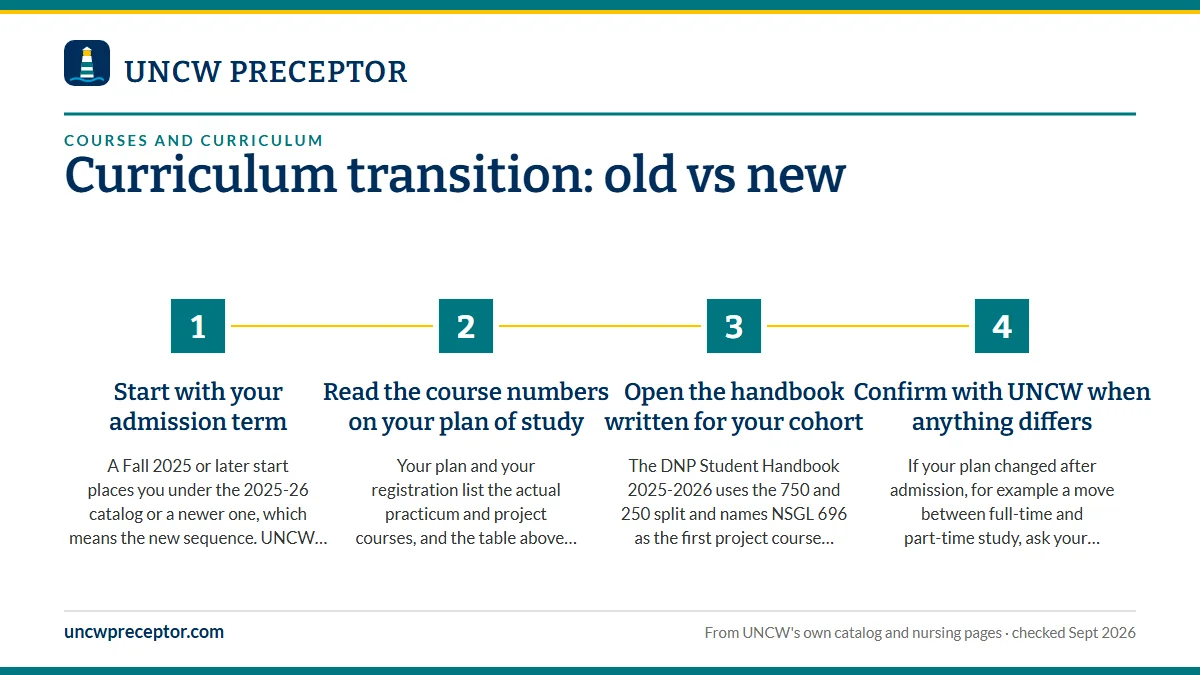
- Start with your admission termA Fall 2025 or later start places you under the 2025-26 catalog or a newer one, which means the new sequence. UNCW says students admitted earlier may be on the previous curriculum, so an earlier start is a strong hint rather than a final answer.
- Read the course numbers on your plan of studyYour plan and your registration list the actual practicum and project courses, and the table above settles most cases in a minute.
- Open the handbook written for your cohortThe DNP Student Handbook 2025-2026 uses the 750 and 250 split and names
NSGL 696as the first project course. The Fall 2025 DNP Immersion and Clinical Hours Handbook still describes the older courses, with 540 clinical and 460 immersion hours, so read it next to your syllabus rather than on its own. - Confirm with UNCW when anything differsIf your plan changed after admission, for example a move between full-time and part-time study, ask your advisor or the Graduate Clinical Coordinator which sequence applies before you line up a preceptor.
Why UNCW's own pages still disagree
UNCW has updated its documents at different speeds, and a preceptor who reads the wrong one can come away with the wrong course or hour count. The FNP preceptor page is the only one with a transition notice. Archived copies show it appeared between May and June 2026, and it tells preceptors: "Your student will clarify which curriculum they are following."
The AGPCNP preceptor page has no notice at all and still lists only NSGL 636, NSGL 638 and NSGL 639 at 180 hours each. The PMHNP preceptor page uses the new NSGL 646–NSGL 649 numbers, while the Fall 2025 clinical hours handbook still walks through NSGL 643–NSGL 645. The Preceptor's Corner main page asks preceptors to plan for about 180 hours a semester and 600 in total, a figure that fits neither sequence; our hours-per-course guide lays out each version.
The 2026-27 catalog's course list still carries every older number, from NSGL 620 to NSG 699, which fits cohorts that are still finishing on them. UNCW has not published a last term for any of these courses.
Your preceptor may have read a UNCW page written for the other curriculum. Send your course number, the syllabus hour target and the semester dates with every request so nobody plans around the wrong figures.
What the new sequence means for your preceptor search
Four practicum semesters instead of three means one more preceptor agreement to secure. In the full-time plans the four practica run back to back from the spring of year two to the spring of year three, summer included. The final FNP and AGPCNP course asks for 240 hours in one term, which favors preceptors with steady clinic volume and room for a student over a long stretch. Each concentration has its own guide: FNP practica, AGPCNP practica and PMHNP practica.
Some rules carried straight across. UNCW states that the FNP patient encounter minimums apply to every student, whichever curriculum they follow. Others are open: the specialty allowance of up to 80 hours was written for the final course of the old FNP and AGPCNP sequences, and UNCW has not said whether it carries over to NSGL 653 or NSGL 663. The project side moved as well, and the DNP project courses guide covers NSGL 696–NSGL 698 and the site approval that comes with them.
Why students on either sequence choose us
Our placement desk works from the course you are registered in, old number or new. We match you with a North Carolina preceptor whose practice fits that course's population and hour target, then prepare what UNCW's Graduate Clinical Coordinator reviews: the preceptor's CV with dates and the site, license number, evaluation email, and the agency's name, address and county. Every request we send names the course, the hours and the term, so the preceptor agrees to the right commitment from the first conversation.
If a preceptor steps back partway through, we stay on call and search for a replacement. Read how it works, or give us your course number in the form below.
Questions UNCW students ask
Can I switch from the old UNCW curriculum to the new one?
UNCW has not published a process for moving between the two sequences. Its FNP notice says students admitted before the 2025-26 update may be enrolled in the previous curriculum, which leaves room for individual cases. Ask your advisor or concentration lead, and get the answer in writing before you plan preceptors around it.
Do both UNCW curricula add up to 1,000 DNP hours?
Yes, but the mix differs. The Fall 2025 clinical hours handbook counts 540 clinical hours plus 460 immersion hours for the previous sequence. The catalog sets 750 direct patient care hours plus 250 non-patient hours for the new one, even though the four FNP or AGPCNP course pages add up to 780.
Is UNCW discontinuing the old FNP practicum courses?
No end date has been announced. The 2026-27 catalog still lists NSGL 620, NSGL 621 and NSGL 622, along with the older AGPCNP and PMHNP practica, which points to cohorts still finishing them. Part-time students on the previous sequence can be several terms from their last practicum, so treat both sequences as current.
What should I send a preceptor who read UNCW's preceptor page?
Send your exact course number, the hour target from your syllabus, the semester dates and a line on the population the course covers. UNCW's preceptor pages are not all current, and the main page's 600-hour figure fits neither sequence. UNCW also expects students to pass along the course objectives and preceptor guidelines.
Does the new PMHNP sequence carry more hours than the old one?
Yes. The previous PMHNP courses, NSGL 643 to NSGL 645, were capped at 180 hours each, 540 in total. The new NSGL 646 to NSGL 649 series lists 187.5 hours per course, or 750 across four semesters, which matches the 750 direct patient care hours in the catalog.
Related pages
Last checked 2026-09-24
We check these pages against UNCW's catalog, handbooks and School of Nursing pages. Your course, your cohort's handbook and UNCW's Graduate Clinical Coordinator have the final word.
- UNCW School of Nursing, DNP FNP Clinical Preceptor and Site Requirements
- UNCW School of Nursing, DNP AGPCNP Clinical Preceptor and Site Requirements
- UNCW 2026-27 Graduate Catalog, DNP Family Nurse Practitioner Concentration
- UNCW DNP Immersion and Clinical Hours Handbook (Fall 2025)
- UNCW DNP Student Handbook 2025-2026
UNCW asks you to find your own North Carolina preceptor. Let us run that search.
Tell us your UNCW program, your practicum course and where in North Carolina you can travel. We find preceptors who fit the course and prepare the CV, license and agency details UNCW's Graduate Clinical Coordinator reviews, well before the deadline.
- Preceptors matched to the course: primary care, pediatrics and women's health for
NSGL 650toNSGL 653, adult and older-adult care for AGPCNP, psychiatric care for PMHNP - Preceptor CV with dates and site, license number and agency details ready for your submission
- In Wilmington, the Cape Fear region or wherever in North Carolina your clinicals can happen
Start your placement plan
Your program, city and next practicum term is all we need to begin.