UNCW's AGPCNP practicum courses, NSGL 660 to NSGL 663
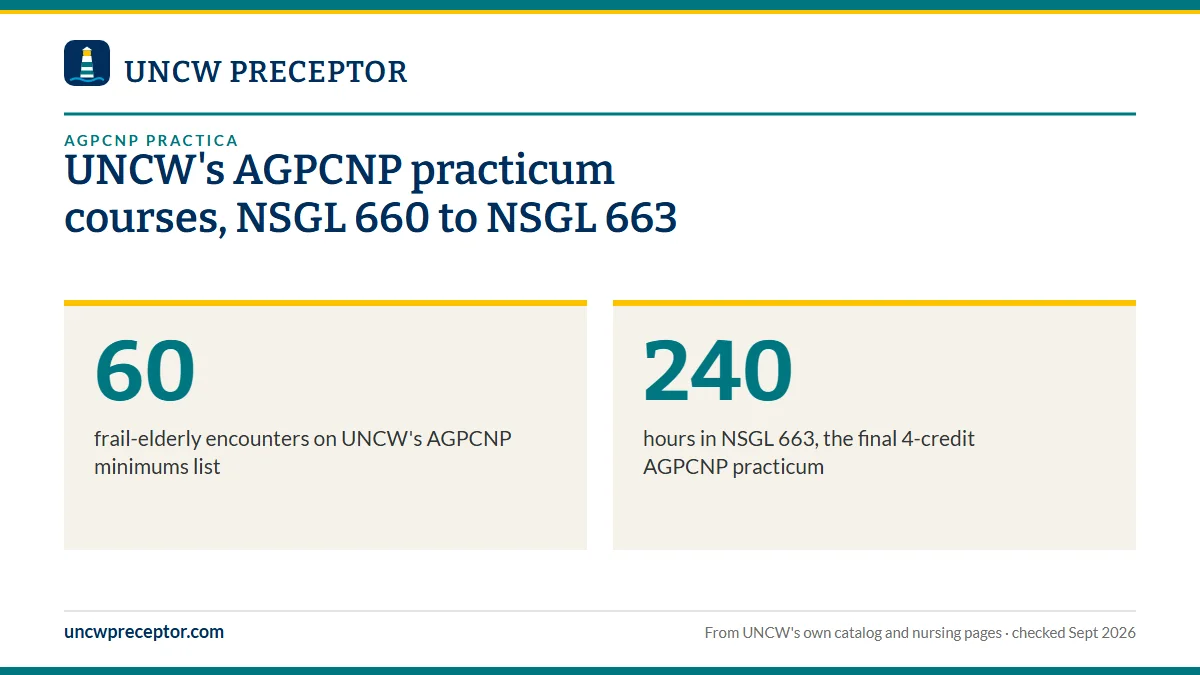
UNCW's Adult-Gerontology Primary Care NP students complete four practica in the current curriculum: NSGL 660, NSGL 661 and NSGL 662 at 180 hours each and NSGL 663 at 240, with patients aged 13 to end of life in primary care settings. Two rules shape every placement: at least one of your preceptors must be an NP, and the program asks for 60 frail-elderly encounters, which the plan of study words as 60 hours.
Get your placement plan
Tell us your UNCW program and where you live. A placement advisor replies with the preceptor and site options that fit your UNCW course.
The AGPCNP practica, course by course
The four practica sit in UNCW's 72-credit BSN-DNP AGPCNP plan beside three concentration courses: NSG 616 (adolescents, older adults and gender health), NSG 617 (pharmacotherapeutics and diagnostic reasoning for the older adult) and NSG 618 (complex health problems). Hours come from the catalog course pages, terms from UNCW's AGPCNP plans of study.
| Course | Title | Credits | Hours | Full-time | Part-time |
|---|---|---|---|---|---|
NSGL 660 | Advanced Adult-Gerontology Nursing Practicum I | 3 | 180 | Spring, year 2 | Spring, year 4 |
NSGL 661 | Advanced Adult-Gerontology Nursing Practicum II | 3 | 180 | Summer, year 2 | Summer, year 4 |
NSGL 662 | Advanced Adult-Gerontology Nursing Practicum III | 3 | 180 | Fall, year 3 | Fall, year 5 |
NSGL 663 | Advanced Adult-Gerontology Nursing Practicum IV | 4 | 240 | Spring, year 3 | Spring, year 5 |
NSGL 660 requires NSG 612, and NSGL 662 lists NSG 616 among its prerequisites. Part-time AGPCNP students reach their first practicum in semester 11, later than part-time FNP or PMHNP students, which leaves a long runway for the search; the first clinical semester guide compares the plans. The course pages add up to 780 direct hours, the catalog's exit requirement says 750 direct plus 250 non-patient, and the AGPCNP plan of study says 780 plus 250. Your syllabus settles it.
Ages 13 to end of life: choosing the right settings
The catalog defines the AGPCNP population as patients aged 13 to end of life in primary care settings. UNCW's clinical handbook turns that into placement guidance: practices providing primary care to adolescents, adults, older adults and women, excluding maternity, all over age 13. It names long-term care, geriatric practices, internal medicine, family medicine and urgent care as ideal.
Two practical points follow. A family medicine office can be an excellent fit, but its visits with children under 13 sit outside the population UNCW defines for you, so check that the adult and adolescent schedule is full enough. And because maternity is excluded, your gynecologic visits need to come from primary care or women's health settings rather than prenatal clinics.
The frail-elderly requirement and other minimums
UNCW's AGPCNP preceptor page and clinical handbook list 60 frail-elderly encounters among the program minimums. The AGPCNP plan of study words it differently: at least 60 hours of frail elderly care across NSGL 660–NSGL 663. The two sources count different things, so ask course faculty which measure your cohort records in Typhon, and aim to satisfy both.
The other minimums, as UNCW lists them:
- Adolescents: two categories of 20 encounters each
- Adults: 70 episodic or wellness and 70 chronic
- Geriatric: two categories of 70 each
- Frail elderly: 60
- Gynecologic, excluding maternity: 20, including 10 speculum or bimanual exams
- Mental health: 40 in the handbook, a row the preceptor page labels as men's health
- Men's health: 10
The preceptor page also labels its geriatric rows as under 65 where the handbook says over 65, so confirm the definitions with course faculty. Long-term care and geriatric practices are the natural home for frail-elderly visits, and starting them in NSGL 660 keeps the final course from becoming a catch-up term.
Who can precept, and the NP rule
AGPCNP preceptors can be NPs, physicians (MD or DO) or PAs practicing in North Carolina, and UNCW adds a condition specific to this concentration: at least one preceptor during the program must be an NP. APRN preceptors hold an RN license, current Approval to Practice and board certification; physicians and PAs hold a current North Carolina license and board certification. Each needs at least a year as a provider, preferably at the site you want. Our preceptor requirements page has the complete list.
An internist or geriatrician can anchor one or more courses. Build the NP requirement in early rather than counting on the last term to supply it, since NSGL 663 is also your longest and least flexible practicum.
The previous sequence: NSGL 636, 638 and 639
Under the 2024-25 catalog, the AGPCNP plan ran 68 credits with three practica, NSGL 636, NSGL 638 and NSGL 639, at 180 hours each, plus the NSGL 681 residency and NSG 699 for the project. The catalog describes NSGL 639 as "the final 180-hour practicum experience" with a clinical preceptor in primary care.
The older handbook allows up to 80 specialty hours in that final course with the Graduate Clinical Coordinator's clearance and one specialty clinic per program, citing examples such as dermatology, cardiology, orthopedics, urology, HIV care and palliative or hospice care. UNCW has not said whether the allowance applies to NSGL 663.
One quirk matters for your search: UNCW's AGPCNP preceptor page still shows only these three older courses, with no transition notice, so a preceptor reading it will expect 180 hours every term. The curriculum transition guide explains the switch.
Why AGPCNP students choose us
AGPCNP placements carry more conditions than they first appear to: an age floor of 13, a frail-elderly target, at least one NP preceptor and a 240-hour final term. We plan the four courses together and match you with North Carolina practices, from internal and family medicine to geriatric and long-term care settings, whose patient panels move you toward each minimum. Every request we send names the new course number and its hours, which matters while UNCW's own AGPCNP page still lists the old ones.
We prepare the preceptor and agency details the Graduate Clinical Coordinator reviews, so your packet arrives complete, and we stay on call if a preceptor drops. Read the AGPCNP program overview, see how it works, or send your plan of study through the form below.
Questions UNCW students ask
Can a family nurse practitioner precept a UNCW AGPCNP student?
Yes, if the FNP practices in North Carolina and meets UNCW's credential rules, and an FNP preceptor also counts toward the requirement that at least one preceptor be an NP. Family medicine is on UNCW's list of ideal AGPCNP settings. Check that the practice sees enough patients aged 13 and older, since younger children fall outside your population.
Does long-term care count for UNCW AGPCNP clinical hours?
Yes. UNCW's clinical handbook names long-term care among the ideal AGPCNP settings, next to geriatric practices, internal medicine, family medicine and urgent care. It is also the most direct route to the 60 frail-elderly encounters, though the site still needs a qualifying preceptor and the Graduate Clinical Coordinator's approval.
Do AGPCNP students need women's health experience?
Some. UNCW's minimums include 20 gynecologic encounters with 10 speculum or bimanual exams, and the handbook lists women's health among the AGPCNP placement areas. Maternity care is excluded, so plan these visits in adult primary care, internal medicine or a gynecology office.
Can a physician precept me for the whole AGPCNP program?
Not for all of it. UNCW lets physicians (MD or DO) and PAs precept AGPCNP students, but at least one preceptor during the program must be an NP. A physician can carry one or more of the four practica, as long as an NP precepts you at some point before you finish NSGL 663.
Can I stay at one site for all four AGPCNP practica?
UNCW's clinical handbook allows one site for the whole program when it meets each course's objectives. For AGPCNP that means a practice with adolescents, adults, older adults and frail-elderly patients in enough volume, plus an NP preceptor at some point. A second site for part of a course can fill any gap.
Related pages
Last checked 2026-09-24
We check these pages against UNCW's catalog, handbooks and School of Nursing pages. Your course, your cohort's handbook and UNCW's Graduate Clinical Coordinator have the final word.
UNCW asks you to find your own North Carolina preceptor. Let us run that search.
Tell us your UNCW program, your practicum course and where in North Carolina you can travel. We find preceptors who fit the course and prepare the CV, license and agency details UNCW's Graduate Clinical Coordinator reviews, well before the deadline.
- Preceptors matched to the course: primary care, pediatrics and women's health for
NSGL 650toNSGL 653, adult and older-adult care for AGPCNP, psychiatric care for PMHNP - Preceptor CV with dates and site, license number and agency details ready for your submission
- In Wilmington, the Cape Fear region or wherever in North Carolina your clinicals can happen
Start your placement plan
Your program, city and next practicum term is all we need to begin.