UNCW's 1,000-hour DNP requirement
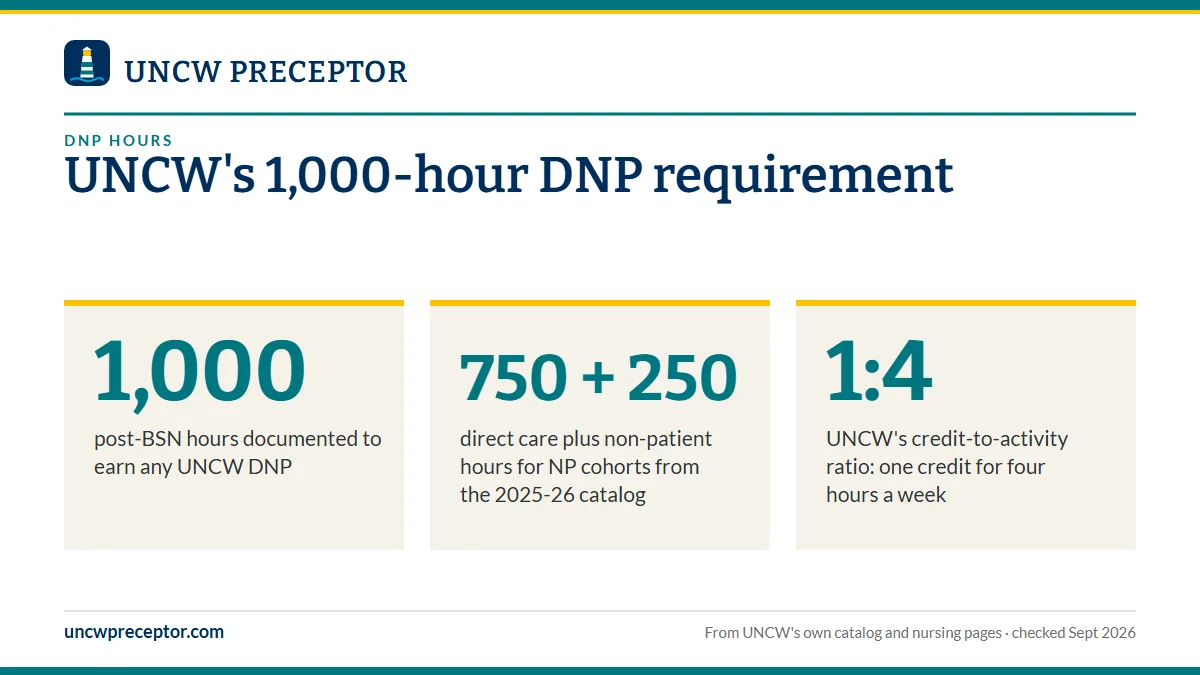
Every UNCW DNP concentration requires 1,000 documented hours after the BSN. How those hours divide depends on your concentration and your catalog year: new NP cohorts split them 750 direct care and 250 non-patient, earlier NP cohorts split them close to half and half, and Post APRN and Nurse Executive Leadership students bring master's hours toward the total.
Get your placement plan
Tell us your UNCW program and where you live. A placement advisor replies with the preceptor and site options that fit your UNCW course.
What the rule says
The 2025-26 DNP Student Handbook states it plainly for BSN-DNP students: "1,000 advanced practice post-BSN clinical/immersion hours must be documented to earn a DNP degree." For the three NP concentrations it adds that at least 750 of them are clinical hours in the concentration or population focus and that "An additional 250 immersion hours are required."
The 2026-27 catalog repeats the rule in the exit requirements for FNP, AGPCNP and PMHNP: a 1,000-hour total, with 750 hours of direct patient care and the other 250 away from it. It labels the 250 "non patient care hours" for FNP and AGPCNP and "indirect patient care clinical hours" for PMHNP. Both labels describe hours that come from somewhere other than seeing patients with your preceptor.
The word documented matters. An hour that never reaches your log, or that breaks one of UNCW's counting rules, does nothing for the 1,000. Program-by-program totals for every UNCW track sit on the clinical hours overview.
New curriculum versus the older catalogs
UNCW rebuilt its NP practicum sequences for students who entered on the 2025-26 catalog or a later one, and the split of the 1,000 hours changed with them. Students admitted earlier may still be finishing under the old split, and your cohort's handbook tells you which one you follow.
| Cohort and source | Direct patient care | Non-patient or immersion |
|---|---|---|
| New NP curriculum, 2025-26 and 2026-27 catalogs | 750 | 250 |
New FNP and AGPCNP course pages (NSGL 650 to NSGL 653, NSGL 660 to NSGL 663) | 780 (180 + 180 + 180 + 240) | 250 on the AGPCNP plan page |
New PMHNP plan (NSGL 646 to NSGL 649) | 750 (4 x 187.5) | 250 |
| Older catalogs, 2023-24 and 2024-25 | 500 | 500 |
| Fall 2025 clinical handbook, older sequences | 540 (3 x 180) | 460 |
The older model also carried a residency course, NSGL 681, and a DNP project course taken twice; the new model replaces both with three project courses. The curriculum transition guide shows how to tell which sequence is yours.
Why direct care reads 750 in one place and 780 in another
For FNP and AGPCNP students on the new sequence, the course hours outrun the catalog's stated minimum. Three practica at 180 hours and a 240-hour capstone make 780, thirty more than 750. The AGPCNP plan page pairs 780 direct hours with 250 non-patient hours, which is 1,030, while the catalog holds the total at 1,000.
Each practicum is graded on its own hours, so those are the numbers to plan around; practicum hours per course lists them one by one. If the 30-hour gap matters for your graduation audit, the Graduate Clinical Coordinator or your concentration lead can tell you how UNCW applies it to your cohort.
PMHNP has no such gap. Four practica at 187.5 hours make exactly 750, the same figure the catalog gives.
Post APRN and Nurse Executive Leadership
The two master's-entry concentrations reach 1,000 another way, because neither has a clinical practicum. For Post APRN, the catalog counts the clinical hours from your previous master's program, set at 500, and adds whatever immersion hours the DNP itself requires. The DNP Student Handbook describes both concentrations as a master's share capped at 500 APRN hours plus a DNP immersion share of no less than 500.
The Nurse Executive Leadership catalog entry frames it as 1,000 post-baccalaureate practice hours. If your master's practicum logged under 500 hours, you make up the shortfall with additional hours, and UNCW's clinical handbook places the work of finding, securing and logging them on the student, with course faculty and your advisor there to help.
One conflict to settle early: the Fall 2025 clinical handbook's course tables expect about 430 immersion hours for Post APRN, below the DNP Student Handbook's floor of 500. Ask your program coordinator which number your cohort is held to.
What 1:4 means for your week
UNCW's clinical handbook sets a 1:4 ratio: each credit hour stands for four hours of activity a week. Applied to the practica, a 3-credit course works out to about 12 hours of clinical activity a week and the 4-credit capstone to about 16. That is our arithmetic from UNCW's ratio, not a published schedule, and it assumes a full-length semester.
Across a spring semester running mid-January to the end of April, 12 hours a week lands close to 180 hours. A summer term squeezes the same hours into fewer weeks. For your preceptor search, that means a preceptor who can give you roughly a day and a half of clinic time in most weeks, and more for the capstone and in summer. Non-patient hours build separately, mainly through the DNP project courses, covered in immersion hours.
Where we fit in your 1,000 hours
The direct-care hours are the ones that depend on another person's calendar, and they are where UNCW NP students lose the most time. We are specialists in UNCW's process: your placement advisor finds North Carolina preceptors whose clinic schedules can carry each practicum's hours, confirms the fit against your course before anything goes to UNCW, and prepares the preceptor's CV, license number and site details for the Graduate Clinical Coordinator's review.
Because the new sequences run practicum after practicum, spring, summer, fall and spring, we plan the whole run together. Where a single site can keep you across several courses we build around it, keeping in mind that PMHNP students need more than one site across the program, and we line up your next preceptor before the current practicum ends. Send your concentration and the year you started through the form below, and your advisor will map the hours still ahead.
Questions UNCW students ask
Do my master's clinical hours count toward UNCW's DNP 1,000?
For Post APRN and Nurse Executive Leadership students, yes. UNCW's DNP Student Handbook lets as many as 500 hours from an APRN master's count, provided the DNP adds 500 or more immersion hours. Nurse Executive Leadership students whose master's practicum totaled under 500 hours complete extra hours to close the gap. BSN-DNP students earn all 1,000 inside the program.
Are the 250 non-patient hours done with my preceptor?
No. They are immersion hours, which UNCW describes as not patient-focused and without an assigned preceptor. For BSN-DNP students they build through the DNP project courses, NSGL 696 to NSGL 698, where the DNP Student Handbook expects about 120 immersion hours in each. Your project faculty and your project site shape where those hours happen.
Do my 600 hours of RN experience count toward the 1,000?
No. The 600 hours of RN work experience are a condition you meet before your first clinical course, not part of the DNP total. The DNP Student Handbook requires BSN-DNP students to obtain their minimum of 1,000 hours during the DNP program, after the BSN, through the practica and the immersion work tied to the DNP project.
Does the PMHNP Post-Doctoral Certificate require 1,000 hours?
UNCW has not published a certificate-specific hour total. The certificate shares its four practica with the DNP PMHNP, NSGL 646 to NSGL 649, which the DNP plan of study assigns 187.5 hours each, but it has no DNP project courses. The PMHNP concentration lead, who also oversees the certificate, can confirm the total for your cohort.
Which UNCW source is right about the 1,000 hours?
They agree on the 1,000 total and differ on the split. The catalog and the 2025-26 DNP Student Handbook describe 750 plus 250 for new NP cohorts, while the Fall 2025 clinical handbook still describes the older 540 plus 460. Which applies depends on your admission year, and the handbook for your cohort and the Graduate Clinical Coordinator confirm it.
Related pages
Last checked 2026-09-24
We check these pages against UNCW's catalog, handbooks and School of Nursing pages. Your course, your cohort's handbook and UNCW's Graduate Clinical Coordinator have the final word.
- UNCW School of Nursing DNP Student Handbook 2025-2026
- UNCW DNP Program Immersion & Clinical Overview (Fall 2025)
- UNCW Graduate Catalog 2026-27: DNP, Family Nurse Practitioner Concentration
- UNCW Graduate Catalog 2026-27: DNP, Post APRN Concentration
- UNCW Graduate Catalog 2026-27: DNP, Nurse Executive Leadership Concentration
UNCW asks you to find your own North Carolina preceptor. Let us run that search.
Tell us your UNCW program, your practicum course and where in North Carolina you can travel. We find preceptors who fit the course and prepare the CV, license and agency details UNCW's Graduate Clinical Coordinator reviews, well before the deadline.
- Preceptors matched to the course: primary care, pediatrics and women's health for
NSGL 650toNSGL 653, adult and older-adult care for AGPCNP, psychiatric care for PMHNP - Preceptor CV with dates and site, license number and agency details ready for your submission
- In Wilmington, the Cape Fear region or wherever in North Carolina your clinicals can happen
Start your placement plan
Your program, city and next practicum term is all we need to begin.