UNCW's PMHNP practicum courses, NSGL 646 to NSGL 649
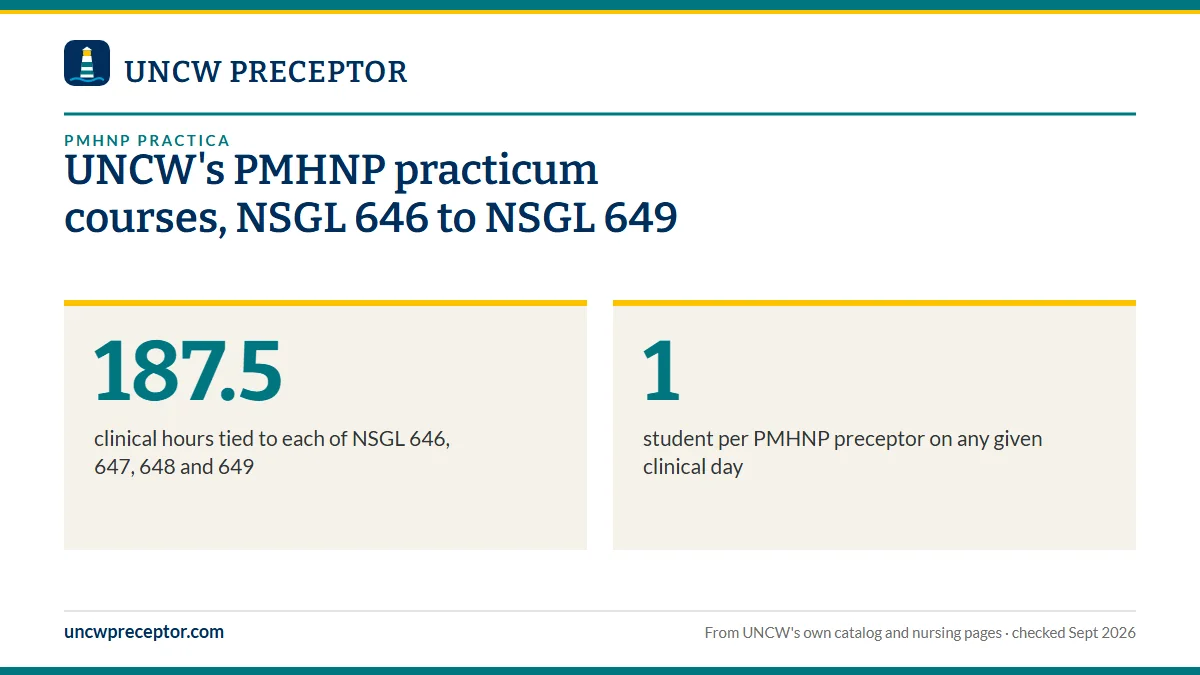
UNCW's PMHNP students complete four 3-credit practica, NSGL 646 through NSGL 649, each tied to 187.5 clinical hours in psychiatric outpatient and inpatient settings. The mix has to include therapy and medication management, a preceptor can host only one student on any clinical day, and the catalog marks every one of these courses as unrepeatable, so each placement has to hold.
Get your placement plan
Tell us your UNCW program and where you live. A placement advisor replies with the preceptor and site options that fit your UNCW course.
Four practica, 187.5 hours each
UNCW's PMHNP plan of study states that each practicum has 187.5 clinical hours associated with it, which adds up to the 750 direct patient care hours the catalog requires within the DNP's 1,000. The catalog course pages give no hour figure, so the plan of study and your syllabus are the sources to follow. UNCW's PMHNP preceptor page calls NSGL 646 the first of a four-part series.
| Course | Title | Hours | Full-time plan | Part-time plan |
|---|---|---|---|---|
NSGL 646 | PMHNP Across the Lifespan Clinical Practicum I | 187.5 | Spring, year 2 | Fall, year 4 |
NSGL 647 | PMHNP Across the Lifespan Clinical Practicum II | 187.5 | Summer, year 2 | Summer, year 4 |
NSGL 648 | PMHNP Across the Lifespan Clinical Practicum III | 187.5 | Fall, year 3 | Fall, year 5 |
NSGL 649 | PMHNP Across the Lifespan Clinical Practicum IV | 187.5 | Spring, year 3 | Spring, year 5 |
NSGL 646 requires NSG 601, NSG 602, NSG 603, NSG 630 and NSG 631. The same four practica serve the MSN-DNP pathway and the new PMHNP Post-Doctoral Certificate, whose plans of study UNCW has not published, so students on those routes confirm their practicum terms with the concentration lead.
Outpatient and inpatient, therapy and medication management
The catalog places these practica in psychiatric outpatient and inpatient settings, and the Preceptor's Corner says PMHNP students need a variety of inpatient and outpatient experiences, therapy and medication management among them. UNCW has not published a setting chart for the new series, but the Fall 2025 clinical handbook's chart for the older courses shows the range it expects:
- Therapy: outpatient therapy is the focus.
- Child and adolescent care: inpatient and outpatient settings, with a PMHNP, psychiatrist or psychiatric PA as the primary preceptor for medication management. FNP preceptors are not allowed, and a secondary placement can supply therapy hours.
- Complex care across the lifespan: ACT teams, psychosocial rehabilitation programs, inpatient mental health and inpatient detox, and the placement must include a prescribing provider.
As a planning rule, spread your four courses across at least one outpatient medication-management practice, one inpatient or intensive setting and a source of supervised therapy hours, then check each one against the syllabus for that course.
Who can precept PMHNP students
For medication management, UNCW accepts PMHNPs, psychiatrists and PAs with a psychiatric focus only, and its clinical handbook asks APRN preceptors to work exclusively in psychiatry. Therapy hours can come from licensed clinical social workers, licensed professional counselors, licensed clinical psychologists, licensed marriage and family therapists and licensed mental health counselors, each fully licensed to practice in North Carolina, board certified and fully credentialed by their certifying body. A therapist adds hours but cannot stand in for the prescriber.
Every PMHNP preceptor needs at least a year in practice at the site. UNCW's PMHNP page also says each student-identified preceptor and site must be approved by the PMHNP concentration leader, on top of the Graduate Clinical Coordinator's review. General credential rules are on our preceptor requirements page.
Rules that shape a PMHNP schedule
PMHNP placements carry more scheduling rules than the other NP concentrations. The one preceptors notice first appears on UNCW's PMHNP preceptor page: "Preceptors can only have one student assigned on any given clinical day." The rest come from the clinical handbook:
- Two or more sites. FNP and AGPCNP students may stay at one site for the whole program, but PMHNP students may not; see the one-site rule.
- Not your own department. PMHNP students cannot complete clinical hours in the department where they work.
- Twelve hours a day at most. The handbook caps PMHNP clinical time at 12 hours per day.
- Telehealth from home, within limits. It is allowed with HIPAA safeguards and under the clinical agency's guidance, and telehealth encounters may not exceed half of the total across all rotations.
- Active participation. You must be engaged in at least 25 percent of the therapeutic process, as recorded in Typhon, for a session to count, and a group therapy session counts as one encounter.
- Encounter minimums: 100 child and adolescent (ages 0 to 21), 100 adult (22 to 59) and 20 older adult (60 and over).
One attempt per course, and the insurance fee
The catalog marks NSGL 646–NSGL 649 "Course may not be repeated". That sets them apart from the FNP and AGPCNP practica, which each allow one repeat, and from UNCW's general DNP rule that lets a student who earns a C repeat one course. A placement that falls apart mid-term, leaving hours or encounters short, carries higher stakes here than anywhere else in the DNP. Our grades and progression guide covers what UNCW says about incompletes and dismissal.
Each of the four courses also carries a student blanket professional liability insurance fee, and the DNP handbook requires liability coverage in every clinical semester, billed to your UNCW student account.
A PMHNP practicum cannot be retaken, so line up a backup preceptor option before the term starts rather than after your hours fall behind.
Before NSGL 646: the NSGL 643 to 645 sequence
Cohorts admitted under the 2023-24 catalog took three PMHNP practica: NSGL 643 Clinical Group and Family Therapy, NSGL 644 Clinical Child and Adolescent Mental Health Care and NSGL 645 Clinical Management of Complex Psychiatric Mental Health Problems Across the Lifespan, each set at 180 hours, not to be exceeded. The 2024-25 catalog moved to NSGL 646–NSGL 649 but still paired them with the older NSGL 681 residency and NSG 699 project course.
The Fall 2025 clinical hours handbook still describes the 643 series, while the PMHNP preceptor page uses the new numbers, so tell a preceptor which course you are in before they read either one. The curriculum transition guide compares every version.
Why PMHNP students choose us
A PMHNP search is a scheduling puzzle: two or more sites, a psychiatric prescriber for medication management, licensed therapists for therapy hours, one student per preceptor per day, and no second attempt at any course. We build the plan across all four practica, matching you with North Carolina psychiatric practices, inpatient programs and therapy providers so each term has the right mix, and we confirm your clinical days with each preceptor up front.
We prepare the preceptor and agency details UNCW's reviewers look for and stay on call if a preceptor steps away mid-course, which matters most in courses you cannot retake. Read about the PMHNP program, see how it works, or send your plan through the form below.
Questions UNCW students ask
Can my PMHNP preceptor take another student at the same time?
Not on the same day. UNCW allows a PMHNP preceptor one student on any given clinical day, so a preceptor who already hosts another learner can still take you on different days. Settle the day-of-week split with the preceptor before you submit the placement so the schedule holds for the whole term.
Can I do PMHNP clinical hours where I work?
Not in your own department. UNCW's clinical handbook bars PMHNP students from completing clinical hours in the department where they are employed. The rule does not address other departments in the same organization, so ask the concentration lead before you count on one.
Can a counselor or social worker be my UNCW PMHNP preceptor?
For therapy hours, yes. UNCW accepts LCSWs, LPCs, licensed clinical psychologists, LMFTs and LMHCs as therapy preceptors when they are fully licensed in North Carolina. Medication management has to come from a PMHNP, a psychiatrist or a PA with a psychiatric focus, so a therapist can cover only part of your hours.
Does the PMHNP Post-Doctoral Certificate use the same practicum courses?
Yes. The 31-credit certificate includes NSGL 646 through NSGL 649 alongside the PMHNP didactic courses. UNCW has not published the certificate's plan of study or a certificate-specific hour total, and its licensure rule matches the DNP's requirement to complete clinical hours in North Carolina.
Do UNCW PMHNP students need child and adolescent experience?
Yes. The clinical handbook sets a minimum of 100 child and adolescent encounters, ages 0 to 21, across the program. Its older rotation chart placed that work in both inpatient and outpatient settings, with a PMHNP, psychiatrist or psychiatric PA handling medication management, so plan at least one course around a practice or unit that treats young patients.
Related pages
Last checked 2026-09-24
We check these pages against UNCW's catalog, handbooks and School of Nursing pages. Your course, your cohort's handbook and UNCW's Graduate Clinical Coordinator have the final word.
UNCW asks you to find your own North Carolina preceptor. Let us run that search.
Tell us your UNCW program, your practicum course and where in North Carolina you can travel. We find preceptors who fit the course and prepare the CV, license and agency details UNCW's Graduate Clinical Coordinator reviews, well before the deadline.
- Preceptors matched to the course: primary care, pediatrics and women's health for
NSGL 650toNSGL 653, adult and older-adult care for AGPCNP, psychiatric care for PMHNP - Preceptor CV with dates and site, license number and agency details ready for your submission
- In Wilmington, the Cape Fear region or wherever in North Carolina your clinicals can happen
Start your placement plan
Your program, city and next practicum term is all we need to begin.