How many preceptors you can use in one UNCW course
UNCW's clinical handbook caps each clinical course at four preceptors, with a separate Clinical Placement Packet for every site and preceptor. You may stay at one site for the whole program if it meets each course's objectives, except in PMHNP, and you may go back to an earlier preceptor once the Graduate Clinical Coordinator approves it.
Get your placement plan
Tell us your UNCW program and where you live. A placement advisor replies with the preceptor and site options that fit your UNCW course.
The four-preceptor cap, in UNCW's words
The rule sits in the Fall 2025 DNP Immersion and Clinical Overview handbook: "A clinical site may be able to provide only a portion of the necessary clinical hours. In those cases, students will have clinical experiences at more than one clinical site during the same semester. Students must submit separate Clinical Placement Packet form per site and/or per preceptor. There is a maximum of 4 preceptors per clinical course."
Read that as a unit count. Each preceptor brings their own packet, CV, Partner Site Acknowledgment Form, approval and evaluations. The limit applies to each clinical course, so NSGL 650 and NSGL 651 each allow up to four, even if some names repeat across them. The cap changes how hours are shared, not how many are due: the course total still has to be finished before the last day of classes, however many preceptors split it.
When splitting hours across preceptors helps
A 180-hour or 240-hour course is a lot to ask of one part-time provider. Splitting makes sense when a preceptor works only two days a week, when a practice sees too few children or women's health visits for the course's population, or when a strong site can host you only for a set number of weeks.
Each extra preceptor has a cost in time, though. Every one needs its own packet reviewed, a site that wants an affiliation agreement may take up to six weeks or more to process, and faculty plan a visit to every clinical site you use each semester. Two well-chosen preceptors usually beat four scattered ones.
The practical sweet spot is a main preceptor who carries most of the hours and one or two secondary preceptors who fill the population gaps your course names.
One site for the whole program
UNCW lets you stay at a single site for the entire program, provided that site meets each course's objectives. The handbook then adds, "However, this is not permissible for PMHNP students."
For FNP and AGPCNP students, one strong family or internal medicine practice can carry a lot, but the courses shift focus as you go. In the new FNP sequence, NSGL 650 is foundational across the lifespan, NSGL 651 adds pediatric and adolescent patients, NSGL 652 expands into women's health and complex care, and NSGL 653 is the capstone where you meet every program encounter requirement.
A single site works only if it can serve all four stages. AGPCNP students also need at least one NP preceptor during the program, so a one-site plan built entirely around a physician or PA needs an NP added somewhere. The FNP practicum courses page shows each course's focus.
Why PMHNP students move between sites
The PMHNP track is built around variety. The Preceptor's Corner says PMHNP students "need a variety of inpatient and outpatient experiences including therapy and medication management," and the handbook's rotation chart, written for the older NSGL 643 to NSGL 645 sequence, shows why one site rarely covers it: an outpatient therapy rotation, a child and adolescent rotation across inpatient and outpatient settings, and a complex rotation that "must include a prescribing provider."
Within a rotation, combining preceptors is expected. The child and adolescent chart names a primary placement for medication management with a PMHNP, psychiatrist or psychiatric PA, and allows a secondary placement for therapy hours. Two PMHNP limits apply to every combination: a preceptor can have only one student on any clinical day, and you cannot do clinicals in the department where you work. The PMHNP practicum courses page covers NSGL 646 to NSGL 649.
Going back to a preceptor you had before
The FNP preceptor page is clear that a return is possible: "Students may return to a previous preceptor if appropriate and with approval from the Graduate Clinical Coordinator." The approval is per placement, so a returning preceptor still goes through a new packet for the new course and semester.
"If appropriate" is the working test. A family NP who carried your adult hours in NSGL 650 may be a natural choice for part of NSGL 653, where you consolidate across populations. The same NP is a weaker fit for the course where pediatrics or women's health is the new focus, unless their panel covers it. For PMHNP students, the program-level rule against a single site still applies. Ask early, too: a provider who enjoyed working with you may already have promised the next semester to another student.
Combining preceptors to cover FNP's populations
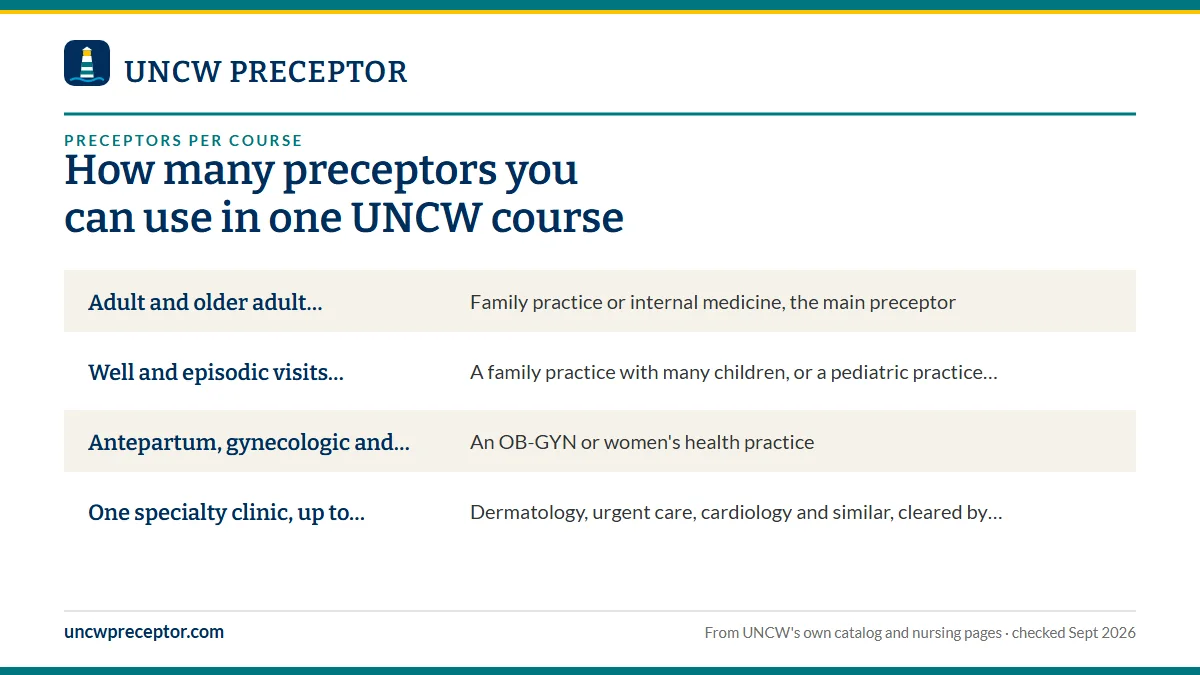
FNP students have the hardest puzzle, because UNCW counts encounters by age group and type, and a student "will be ineligible for graduation, even if they have met all clinical hours," when minimums fall short. The full table is on the FNP patient encounters page. The combination below is one example of how preceptors can divide the load.
| Need | Where it can come from | Preceptor types UNCW allows |
|---|---|---|
| Adult and older adult chronic and episodic care | Family practice or internal medicine, the main preceptor | NP, MD or DO, PA |
| Well and episodic visits from 2 weeks to 19 years | A family practice with many children, or a pediatric practice one day a week | NP, MD or DO, PA |
| Antepartum, gynecologic and newborn exams | An OB-GYN or women's health practice | CNM, NP, MD or DO, PA |
| One specialty clinic, up to 80 hours in the final course | Dermatology, urgent care, cardiology and similar, cleared by the Graduate Clinical Coordinator | Per the specialty |
The specialty allowance comes from the handbook's older-sequence chart, so confirm it for NSGL 653 before you count on it.
How we plan multi-preceptor semesters
UNCW students choose us because we plan the whole mix, not just a single name. We start from your course's population focus and encounter targets, pick a main preceptor who can carry most of the hours, then add the pediatric, women's health or therapy preceptor that closes the gap, staying within UNCW's four-per-course limit. When a site can host you only for part of the term, we line up the next preceptor before the first one's weeks run out, so your hours keep moving.
Every preceptor arrives with the details for a separate packet, and when a return to a past preceptor fits, we flag it so you can ask the Graduate Clinical Coordinator early. Each approval remains the Graduate Clinical Coordinator's call, and each packet we prepare is built to clear it on the first read. Share your course with us, or read how it works first.
Questions UNCW students ask
Does the four-preceptor limit reset each course?
Yes. UNCW's handbook sets "a maximum of 4 preceptors per clinical course," so the count applies to each practicum course on its own. You could work with three preceptors in one course and a different three in the next, as long as each is approved and has its own packet.
Do two preceptors at the same clinic need separate packets?
Yes. UNCW asks for a separate Clinical Placement Packet "per site and/or per preceptor," so a second provider in the same building still needs their own packet, CV and signed acknowledgment. The site's affiliation agreement, if one exists, covers the location for both.
Can a PMHNP student keep one preceptor for two courses?
UNCW rules out a single site for the entire PMHNP program but publishes no rule on repeating a preceptor across two of the four courses. A return needs Graduate Clinical Coordinator approval, and PMHNP placements also need the PMHNP concentration leader's approval, so ask both before you plan around it.
Does a secondary preceptor with only a few hours still count toward the four?
Yes. The cap counts preceptors, not hours, and every preceptor needs a packet regardless of how much time you spend with them. A preceptor who covers a handful of pediatric days uses one of your four slots just as a main preceptor does.
Will I get a faculty site visit at every site?
Clinical faculty, by UNCW's handbook, arrange a visit to each of your clinical sites every semester, and more often when needed. FNP students also need at least one in-person visit during the program. More sites can mean more visits to schedule, which is worth weighing when you plan a split.
Related pages
Last checked 2026-09-24
We check these pages against UNCW's catalog, handbooks and School of Nursing pages. Your course, your cohort's handbook and UNCW's Graduate Clinical Coordinator have the final word.
UNCW asks you to find your own North Carolina preceptor. Let us run that search.
Tell us your UNCW program, your practicum course and where in North Carolina you can travel. We find preceptors who fit the course and prepare the CV, license and agency details UNCW's Graduate Clinical Coordinator reviews, well before the deadline.
- Preceptors matched to the course: primary care, pediatrics and women's health for
NSGL 650toNSGL 653, adult and older-adult care for AGPCNP, psychiatric care for PMHNP - Preceptor CV with dates and site, license number and agency details ready for your submission
- In Wilmington, the Cape Fear region or wherever in North Carolina your clinicals can happen
Start your placement plan
Your program, city and next practicum term is all we need to begin.