UNCW DNP Post APRN: a doctorate built on the practice you already have
The Post APRN concentration is UNCW's 33-credit DNP for working advanced practice nurses. It has no clinical practicum and no assigned preceptor: your hours come from the master's you already finished plus immersion hours on a DNP project, carried out in the state where you are licensed. The real task is securing a project site and someone there to champion the work, and that is where we help.
Need a DNP project site?
Tell us your state and project idea, and we start lining up a site and a mentor where you are licensed.
Post APRN at a glance
The eight courses outside the project are the DNP's doctoral core: NSG 680 population health and clinical epidemiology, NSG 682 genomics, NSG 683 statistics, NSG 685 and NSG 686 on the theory and methods of evidence-based practice, NSG 688 systems leadership and quality improvement, NSG 689 policy and financial management, and NSG 692 information systems. Each is 3 credits, as are the three project courses.
UNCW's application portal describes DNP delivery as online apart from the orientation and any intensives indicated for each concentration, so confirm with the program whether Post APRN students have intensives beyond orientation.
| Item | What UNCW publishes |
|---|---|
| Credits | 33 (11 courses) |
| Who it is for | APRNs with national certification who are working in an advanced practice role |
| Clinical courses | None; three DNP project courses, NSGL 696 to NSGL 698 |
| Hours | 1,000 in total: 500 from your master's plus DNP immersion hours |
| Preceptor | None assigned |
| Project location | The state where you are licensed as an RN and as an APRN |
| Length | 5 semesters full time, 8 part time |
| Admission | Fall; the Fall 2027 cycle opened 09/01/2026, with rolling review to a 04/01/2027 deadline |
| On campus | The DNP Student Handbook lists only the New Student Orientation for this concentration |
How the 1,000 hours add up
UNCW counts 1,000 hours after the BSN. According to the catalog, that total is made of 500 clinical hours carried from your earlier master's plus whatever immersion time the DNP adds. In the DNP Student Handbook's version, your APRN master's supplies no more than 500 of those hours and the doctorate supplies 500 or more in immersion.
The Fall 2025 immersion handbook complicates the picture: its course table expects 430 immersion hours from Post APRN students. The DNP Student Handbook also expects roughly 120 immersion hours in each of the three project courses. Ask your project faculty which target applies to your cohort, and log toward the higher number until you have an answer. The immersion hours guide and the 1,000-hour breakdown explain what counts.
Immersion hours are project work, not patient care. They go into Typhon within 5 days, travel time is excluded, and no hours accrue on days the campus is closed, wherever you happen to be working.
No assigned preceptor: what replaces one
UNCW's immersion handbook is direct about this concentration: immersion hours are not patient-focused, and the student does not have an assigned preceptor. Instead of the NP students' placement packet, you work with project faculty to choose a project and a site, and a leader at that site agrees to support it.
Most Post APRN students complete their immersion hours where they already practice as an APRN. In that case, your employer and UNCW sign a Letter of Agreement. With both project faculty and the practice on board, you then file the DNP Project Intent form and, later, a Letter of Support. If your job is a poor match for your project, you can name another agency and a clinical liaison there, and UNCW will put an affiliation agreement in place if that agency asks for one.
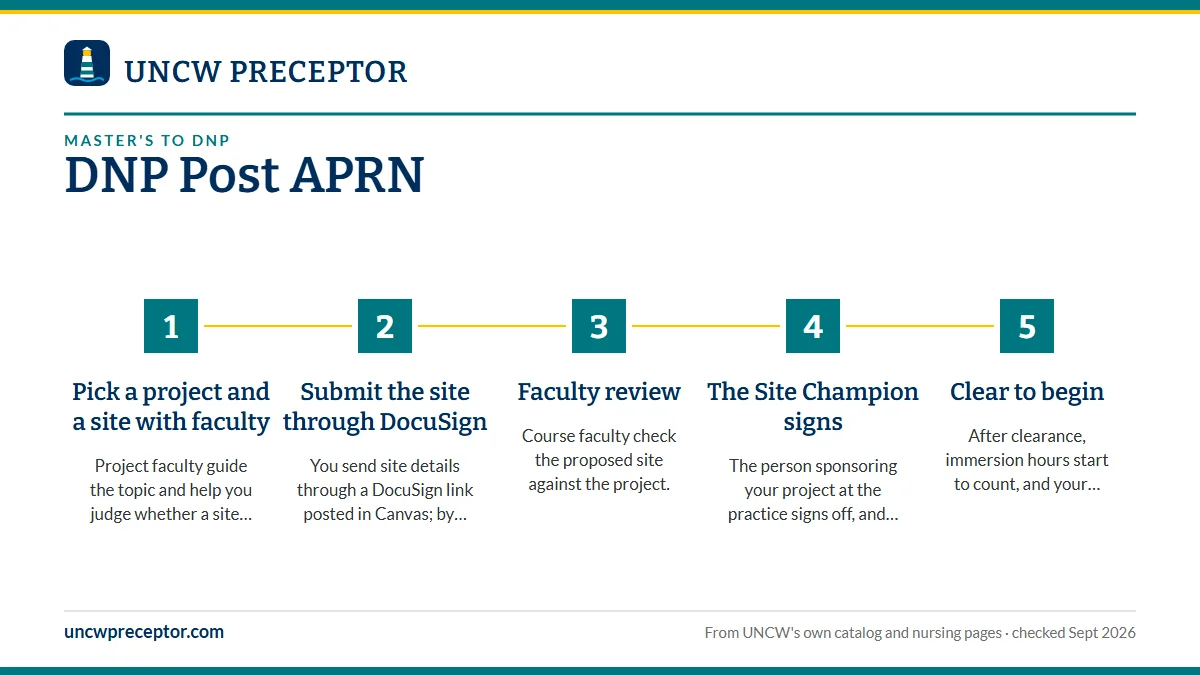
The project approval path
- Pick a project and a site with facultyProject faculty guide the topic and help you judge whether a site can host it.
- Submit the site through DocuSignYou send site details through a DocuSign link posted in Canvas; by the handbook's timeline, site approval paperwork is due during week one of
NSGL 696. - Faculty reviewCourse faculty check the proposed site against the project.
- The Site Champion signsThe person sponsoring your project at the practice signs off, and any Letter of Agreement is completed.
- Clear to beginAfter clearance, immersion hours start to count, and your Letter of Support comes later in the sequence.
Full-time students take NSGL 696 in the summer of year 1, their third semester; part-time students take it in the summer of year 2, their sixth. The Fall 2025 immersion handbook still uses older project course numbers in places, so match any form it mentions to the course you are enrolled in. The DNP project courses page covers each course in turn.
Your project follows your license
To enter the Post APRN track you need an RN license from North Carolina or a compact state, an APRN license or approval to practice, and current national certification. Your project then happens in whichever state issued those credentials. UNCW's admissions wording ties the APRN credential to your state of residence and expects you to be employed in an advanced practice role.
That makes this concentration far more portable than the nurse practitioner tracks, whose clinical hours stay in North Carolina. If you live elsewhere, check how your state treats practice experiences for out-of-state online programs before your project begins; the guide to studying from outside North Carolina summarizes what is known about UNCW's status state by state.
Why Post APRN students work with us
Your project needs a home and a champion, and we help you secure both in the state where you are licensed. If your own practice is the right fit, we help you prepare the request to your leadership and gather the site details your project faculty and the Project Site form ask for. If it is not, your placement advisor finds practices and health systems in your state whose priorities match your project question, and identifies a leader ready to serve as your site champion.
We keep the paperwork moving too: the agency's legal name and address, the person who signs the Letter of Agreement, and the contact UNCW needs if the site requests an affiliation agreement. Starting well before NSGL 696 gives your faculty a complete picture in the first week of the course. Project faculty approve the site; we make sure what they receive is ready. Tell us your state with the form below, or read how it works.
Questions UNCW students ask
Can I complete UNCW's Post APRN DNP from another state?
Yes, in UNCW's published wording. Courses are online, and your project is carried out wherever you are licensed as an RN and an APRN. The admission conditions still apply: a North Carolina or multistate RN license, current national certification and a job in an advanced practice role. Plan one trip for the required New Student Orientation.
What if my APRN master's had fewer than 500 clinical hours?
UNCW's Post APRN catalog entry assumes 500 hours from the master's program, and the handbook says up to 500 can count. The Nurse Executive Leadership concentration states that students with fewer than 500 prior hours complete additional hours, but the Post APRN pages say nothing specific. Ask the program coordinator how your documented master's hours will be counted before you plan your immersion schedule.
How long does the UNCW Post APRN DNP take?
Five semesters is the shortest full-time route UNCW describes; part-time students follow an eight-semester plan. Both plans count summer terms. The first project course, NSGL 696, comes in the third semester full time or the sixth part time, and the DNP Student Handbook allows six years in total.
Is the Post APRN DNP the same as the Nurse Executive Leadership DNP?
No. Both are master's-to-DNP concentrations with project immersion hours and no assigned preceptor, and both share the 04/01/2027 deadline. Post APRN (33 credits) is for working APRNs and counts 500 hours from the APRN master's. Nurse Executive Leadership (36 credits) adds executive courses in finance, law, quality and systems leadership.
How does the UNCW DNP end for Post APRN students?
With a comprehensive exam on your project, taken in writing and orally, as in every UNCW DNP concentration. The student handbook also describes presenting a project poster at DNP Presentation Day near graduation. Throughout, each course needs a B or higher and your cumulative GPA must stay at 3.0 or above.
Related pages
Last checked 2026-09-24
We check these pages against UNCW's catalog, handbooks and School of Nursing pages. Your course, your cohort's handbook and UNCW's Graduate Clinical Coordinator have the final word.
UNCW asks you to find your own North Carolina preceptor. Let us run that search.
Tell us your UNCW program, your practicum course and where in North Carolina you can travel. We find preceptors who fit the course and prepare the CV, license and agency details UNCW's Graduate Clinical Coordinator reviews, well before the deadline.
- Preceptors matched to the course: primary care, pediatrics and women's health for
NSGL 650toNSGL 653, adult and older-adult care for AGPCNP, psychiatric care for PMHNP - Preceptor CV with dates and site, license number and agency details ready for your submission
- In Wilmington, the Cape Fear region or wherever in North Carolina your clinicals can happen
Start your placement plan
Your program, city and next practicum term is all we need to begin.