UNCW's FNP patient encounter minimums
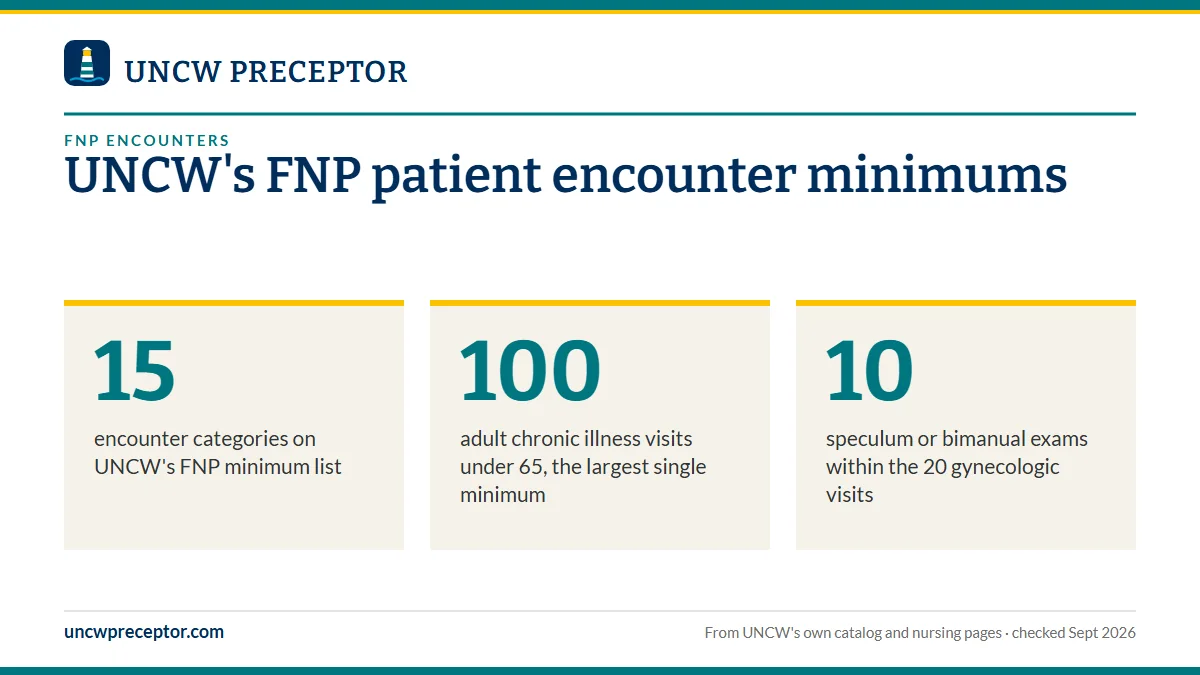
Hours are only half of a UNCW FNP clinical record. By the end of the program you also need minimum counts of patient encounters in fifteen categories, from well-child visits to speculum exams, and UNCW says a student who misses them cannot graduate even with every hour complete. The counts are the same on the old and new FNP sequences.
Get your placement plan
Tell us your UNCW program and where you live. A placement advisor replies with the preceptor and site options that fit your UNCW course.
The rule behind the numbers
UNCW's clinical handbook is blunt: "Students must meet minimums for patient interactions, or they will be ineligible for graduation, even if they have met all clinical hours. Observation visits do not count toward totals." The FNP preceptor page adds that the requirements apply to every student regardless of which curriculum they are enrolled in.
On the new sequence, the capstone is where the last gaps have to close: UNCW's description of NSGL 653 includes meeting all program patient encounter requirements. That makes the capstone the wrong moment to discover you are short twenty well-child visits.
An encounter only counts once it is logged, and only if you took part in the visit rather than watched it, so the categories below are also the categories your Typhon entries are measured against.
The FNP minimum encounters
These counts come from UNCW's FNP preceptor page and the Fall 2025 clinical handbook, which match. They are cumulative across all of your practica.
| Minimum | Encounter type |
|---|---|
| 20 | Ages 2 weeks to 5 years, episodic |
| 20 | Ages 2 weeks to 5 years, well |
| 20 | Ages 6 to 12, episodic |
| 20 | Ages 6 to 12, well |
| 20 | Ages 13 to 19, episodic |
| 20 | Ages 13 to 19, well |
| 50 | Adult episodic or wellness, under 65 |
| 100 | Adult chronic illness, under 65 |
| 70 | Geriatric chronic illness, over 65 |
| 50 | Geriatric episodic or wellness, over 65 |
| 20 | Antepartum visits |
| 10 | Newborn exams, up to 2 weeks old |
| 20 | Gynecologic visits, including 10 speculum or bimanual exams |
| 40 | Mental health visits |
| 10 | Men's health, male genitourinary care, over 18 |
Which sites supply which categories
Few practices fill all fifteen rows on their own. UNCW points FNP students toward primary care, pediatric and women's health experiences, and the older handbook singles out family practice as the ideal setting. For site planning, the rows fall into three groups.
- Family or internal medicine practice: adult episodic and chronic visits, both geriatric rows, much of the mental health count and usually the men's health visits. A family practice that also sees children can cover many pediatric rows too.
- Pediatric practice: the six pediatric rows, 120 encounters in all, split between well and episodic visits, plus newborn exams if the practice sees infants in their first two weeks.
- Women's health or OB/GYN practice: the 20 antepartum visits and the 20 gynecologic visits with their 10 speculum or bimanual exams. Unless a family practice provides prenatal care, these rows need a women's health site.
Four professions can precept an FNP student in North Carolina: nurse practitioners, certified nurse midwives, physicians and physician assistants, and UNCW's handbook wants an NP among your preceptors at some point in the program. Credentials are on preceptor requirements.
Planning the practica around the counts
Each new FNP practicum adds a population. NSGL 650 is foundational care across the lifespan, the second course adds children and teenagers, the third reaches into women's health and more complex patients, and NSGL 653 pulls it all together. Matching sites to that order means pediatric volume by the second practicum and a women's health site by the third; the FNP practicum courses page has the detail.
UNCW allows up to four preceptors in one practicum, each needing a separate placement packet, which lets a semester pair a main family practice with several days at a pediatric or women's health clinic. The limits are on preceptors per course. Keep a running tally against every row and review it at mid-semester, while there is still time to add a site.
Two caps limit shortcuts. Telehealth tops out at 50 credited encounters over the program and has to happen at the clinic, and the older sequence allowed one specialty clinic, capped at 80 hours in the last practicum and cleared by the Graduate Clinical Coordinator. Nothing UNCW has published says whether that carries over to NSGL 653, so confirm before relying on it.
AGPCNP: the 60 frail-elderly encounters
Adult-Gerontology Primary Care NP students have their own list covering patients 13 and older, and one row stands out: 60 frail-elderly encounters. The AGPCNP plan of study phrases the same requirement as a minimum of 60 frail-elderly care hours spread over the four practica, so UNCW's sources disagree on whether the unit is encounters or hours. Choose settings where both are easy to reach.
The rest of the AGPCNP list includes two adolescent rows of 20, 70 adult episodic or wellness, 70 adult chronic, two geriatric rows of 70, 20 gynecologic visits excluding maternity with 10 speculum or bimanual exams, 40 mental health and 10 men's health. UNCW's AGPCNP preceptor page and the handbook label two rows differently, so check the copy in your course. For these placements UNCW favors long-term care and geriatric practices, with internal medicine, family medicine and urgent care also on its ideal list; see AGPCNP practicum courses.
Sites chosen for the counts you still need
An encounter shortfall is a placement problem, and placement is what solves it. Once you sign on with us, your placement advisor starts from your program's encounter rows and your current tallies, then looks for North Carolina preceptors whose patient mix fills the rows you still need: a pediatric office for the well-child counts, a women's health practice for antepartum and gynecologic visits, a practice with heavy geriatric volume for AGPCNP's frail-elderly requirement.
We prepare each preceptor's details for the Graduate Clinical Coordinator's review so a second or third site can be approved within the same semester. If you are partway through and short in a category, behind on clinical hours sets out the options, or send your tallies through the form below.
Questions UNCW students ask
Can one family practice cover all of UNCW's FNP encounter minimums?
Possibly, but only if it offers prenatal and newborn care. A family practice with a steady pediatric panel can cover the adult, geriatric, pediatric, mental health and men's health rows. Antepartum visits and newborn exams in the first two weeks of life depend on whether the practice provides that care; if not, plan a women's health or pediatric site for those rows.
Do PMHNP students have encounter minimums too?
Yes. UNCW's clinical handbook sets PMHNP minimums by age: 100 encounters with children and adolescents up to 21, 100 with adults 22 to 59, and 20 with adults 60 and older. One group therapy session is credited as a single encounter, and PMHNP students must be actively engaged in the therapeutic process for a session to count at all.
Do telehealth visits count as FNP encounters?
Up to a limit. FNP and AGPCNP students get credit for no more than 50 telehealth encounters in total, and each one has to take place on site at the clinic, not at home. Telehealth care beyond that point is still part of your clinical day, but it adds nothing further to your encounter totals.
What counts as a men's health encounter at UNCW?
UNCW's FNP list describes it as male genitourinary care for patients over 18, and it requires 10 such visits. Family practices with an adult male panel and urology practices see these visits; the older FNP handbook named urology among the specialty clinics allowed in the final course, subject to Graduate Clinical Coordinator clearance.
Related pages
Last checked 2026-09-24
We check these pages against UNCW's catalog, handbooks and School of Nursing pages. Your course, your cohort's handbook and UNCW's Graduate Clinical Coordinator have the final word.
UNCW asks you to find your own North Carolina preceptor. Let us run that search.
Tell us your UNCW program, your practicum course and where in North Carolina you can travel. We find preceptors who fit the course and prepare the CV, license and agency details UNCW's Graduate Clinical Coordinator reviews, well before the deadline.
- Preceptors matched to the course: primary care, pediatrics and women's health for
NSGL 650toNSGL 653, adult and older-adult care for AGPCNP, psychiatric care for PMHNP - Preceptor CV with dates and site, license number and agency details ready for your submission
- In Wilmington, the Cape Fear region or wherever in North Carolina your clinicals can happen
Start your placement plan
Your program, city and next practicum term is all we need to begin.